
The water at Taru no Taki has never once stopped falling, and the people who still live beneath it have never once forgotten why a certain family cannot walk its banks. This is the strange inheritance of Serpent’s Grudge: The Hunter of Taru Falls — not a tale invented for the page, but a piece of lived memory from the mountain villages of Kōchi Prefecture, carried forward by voice long before anyone thought to write it down. What follows is an attempt to walk back through that oral record, to the falls, the gun, the hide strung between two trees, and the fire that answered it.
The Mist Above Kurogane Iwa
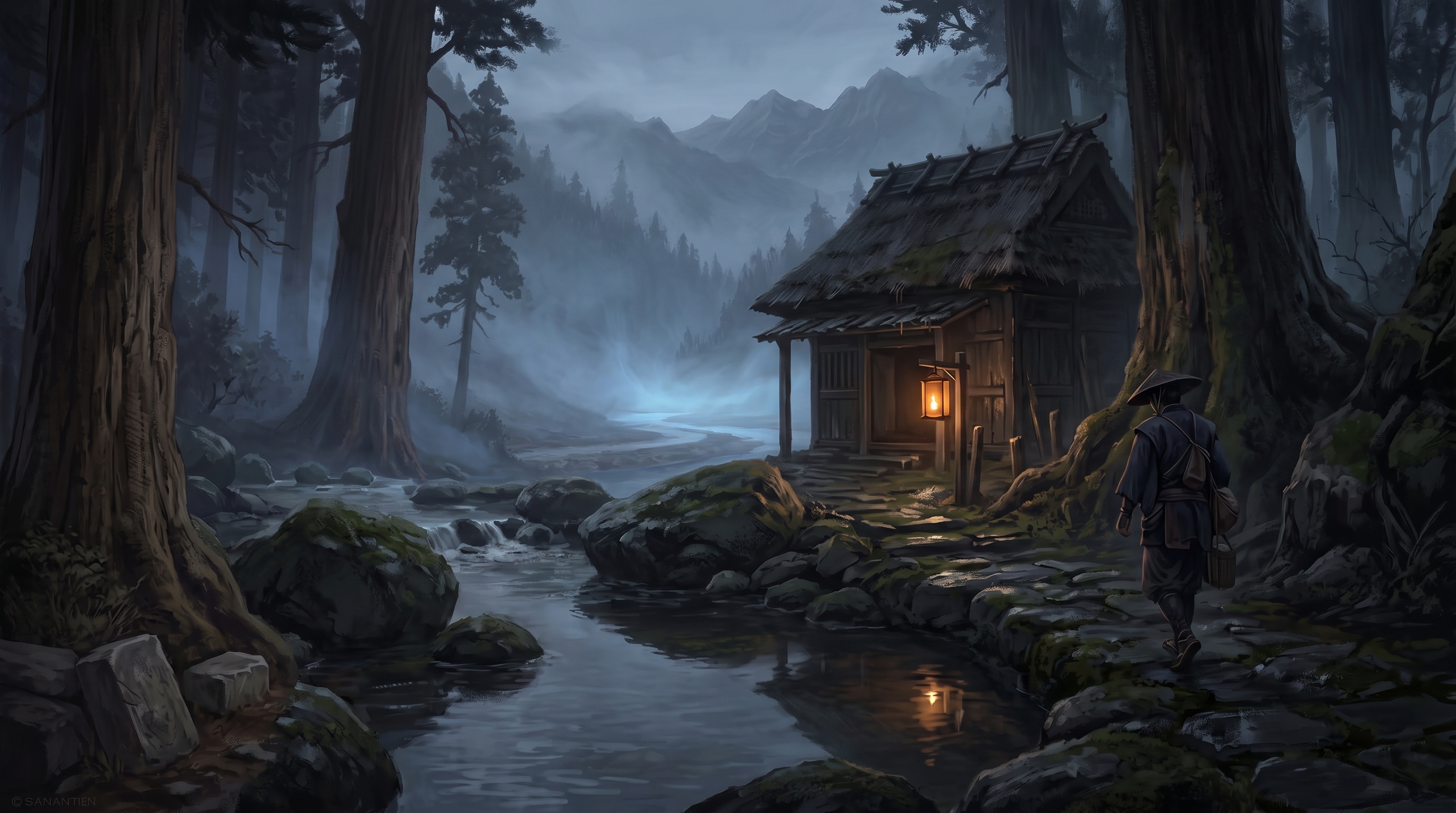
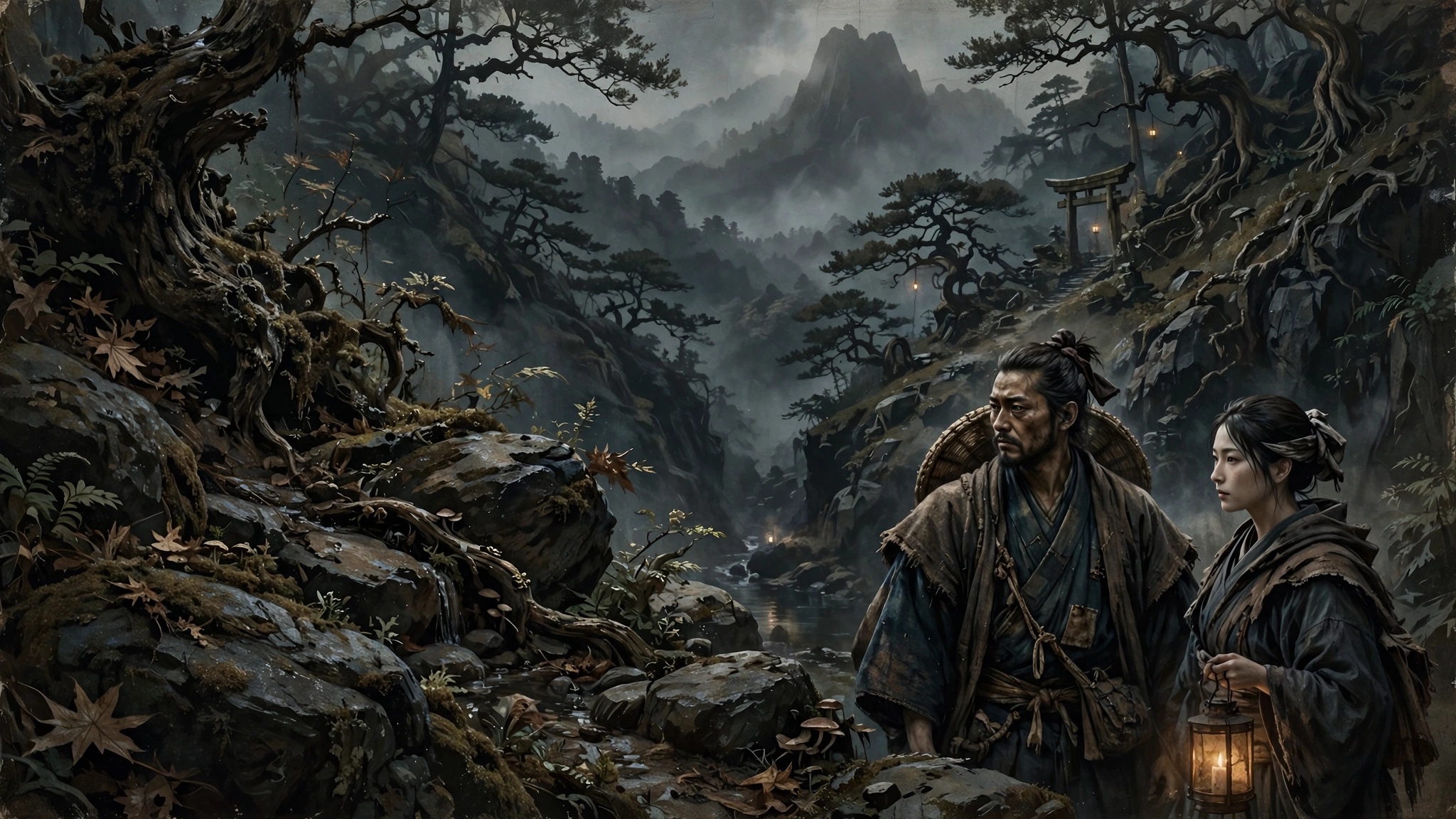 Yokogura Mountain View.
Every version of this kaidan begins the same way: with mist rising before sound. The cascade of Taru no Taki drops several dozen jō down a mountainside on the southern edge of a settlement called Ochi, in Kōchi’s Takaoka District, a village so remote it sits nearer the clouds than any coastal town. At its base lies a black pool, and above that pool a hollow in the stone the villagers named kurogane iwa — the dark iron rock. It is an unremarkable name for an unremarkable cave, until something inside it begins, very slowly, to move.
The oral record gives no firm date for the events that follow. It says only that they happened “not so very long ago” — a phrase the folklore of Takaoka District has preserved almost verbatim across generations of telling. This vagueness is not an oversight. In the structure of regional kaidan, a story kept deliberately close to living memory carries more weight than one safely buried in the distant Edo past. It suggests the wound is still, in some sense, open.
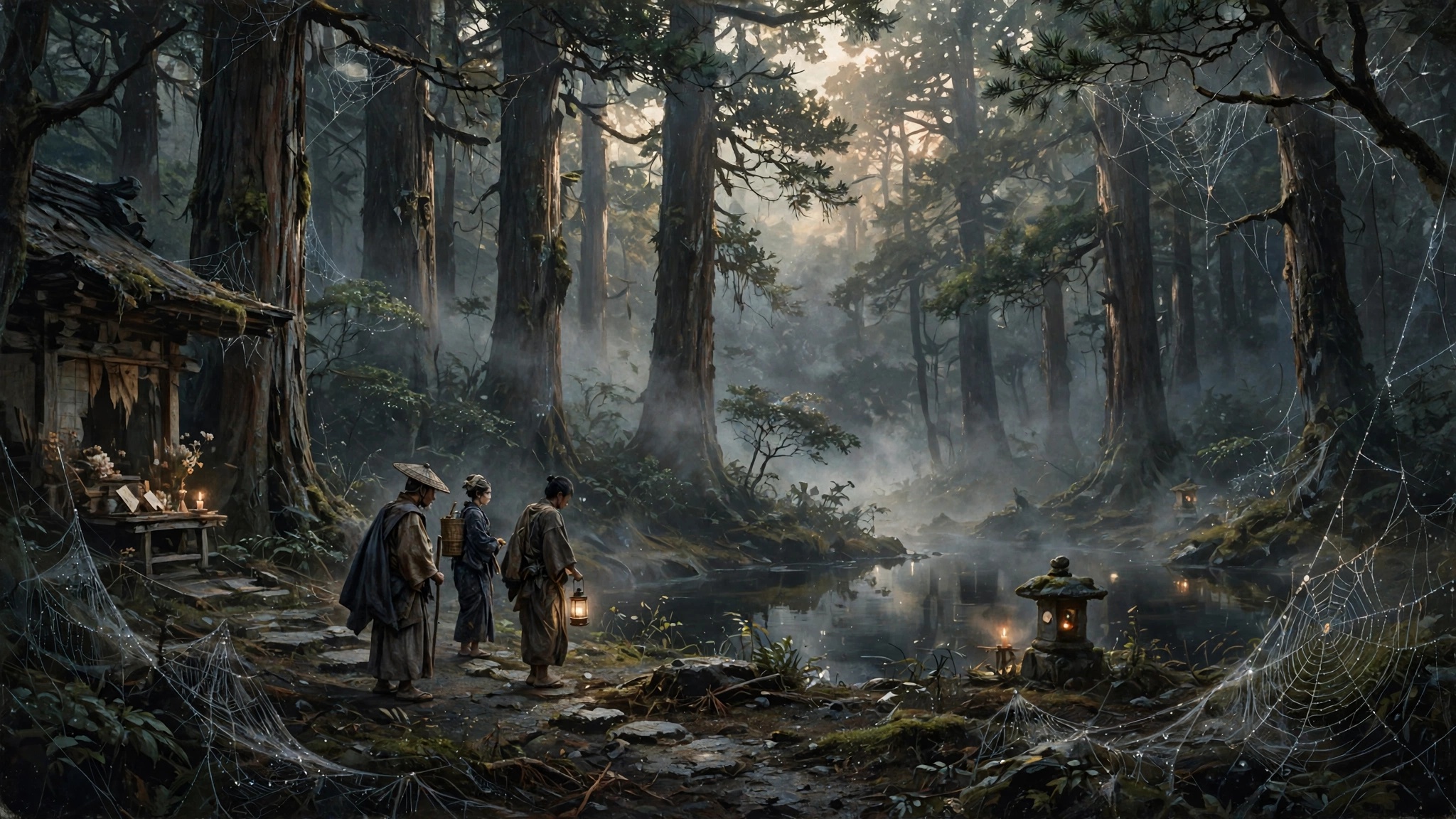
Taru no Taki: Where the Mountain Remembers Antoku
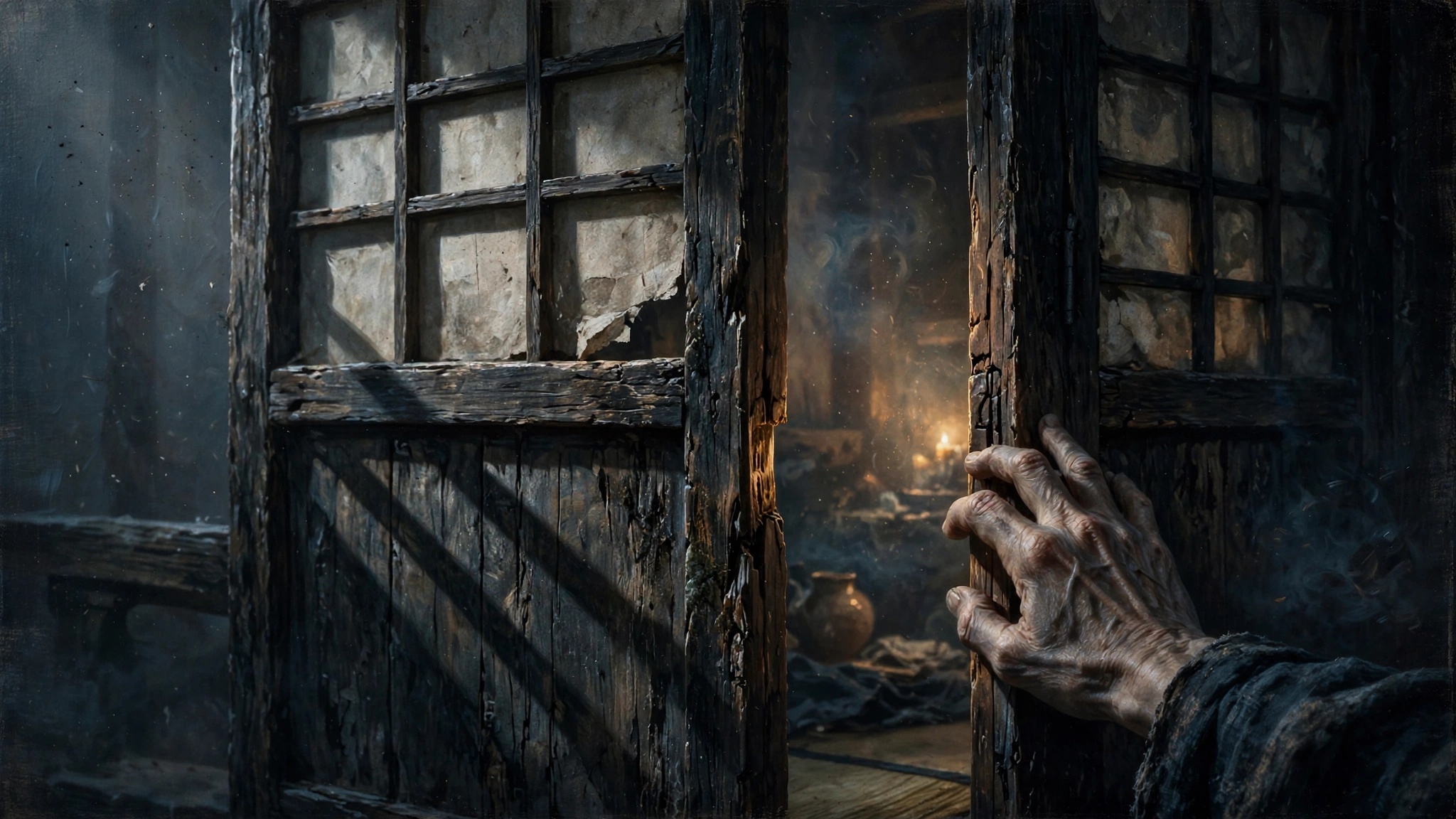
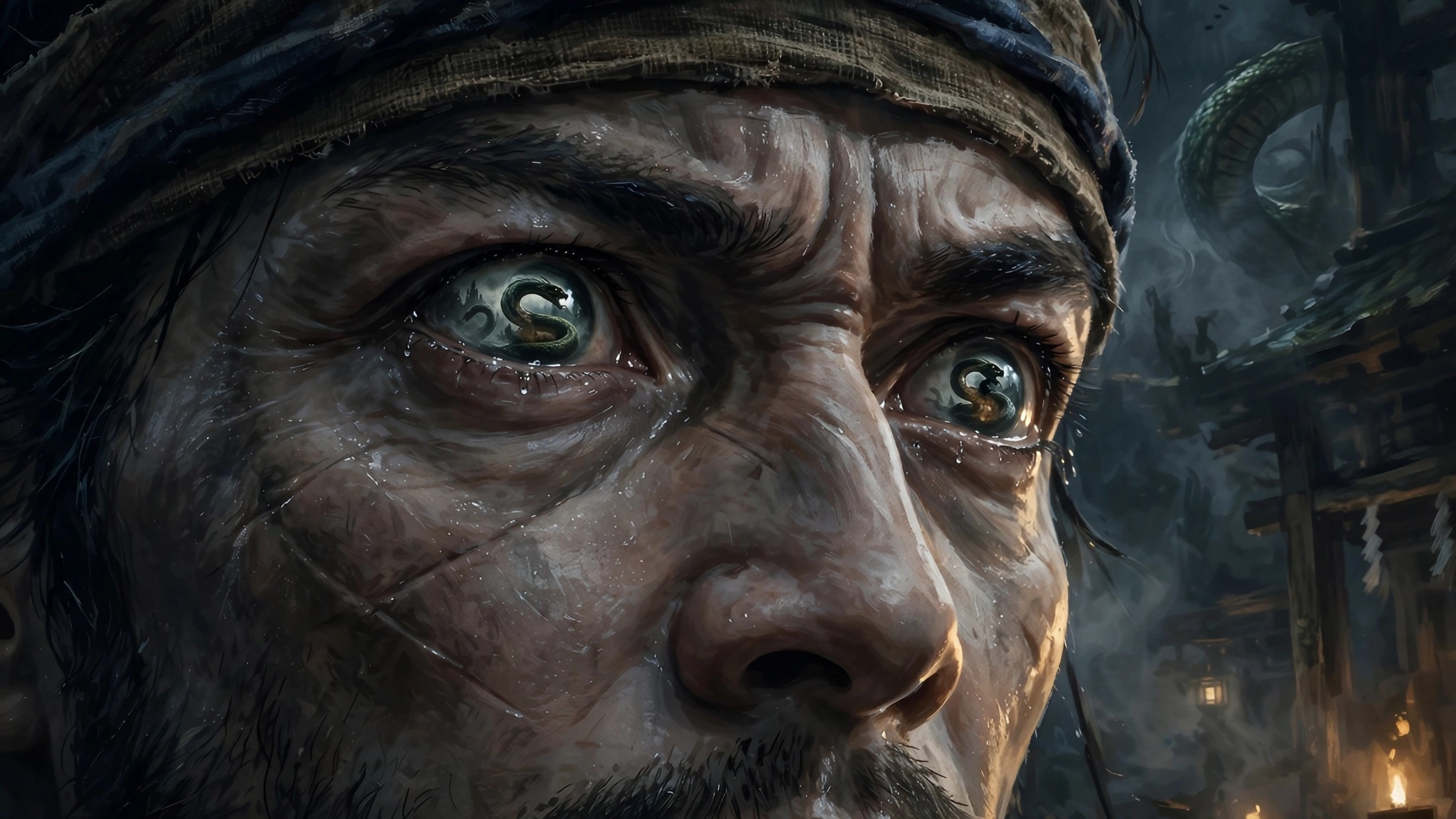 Hunter’s Unwavering Gaze.
The falls themselves carry a second layer of history that the serpent story never fully escapes. Across a deep ravine to the north rises Yokogura, a mountain long associated in local tradition with the burial of Emperor Antoku, the child-emperor drowned at Dan-no-ura in 1185 during the final collapse of the Taira clan. In early summer, viewed from Yokogura’s slopes, Taru no Taki shows itself silver against new green, pouring down with the sound villagers call tōtō — a deep, rolling thunder, as though a great barrel of water were tipped and emptied without end.
This is the pairing that gives the place its character: an imperial grave on one ridge, an endlessly falling cascade on the other, and between them a cave the local hunters avoided speaking of directly. Historical interpretation, not documented fact, suggests that the proximity of Antoku’s legendary resting place lent the entire ravine an atmosphere of consequence long before the Shinohara household ever set foot near the pool. A landscape already marked by royal tragedy does not need much persuading to accept a serpent’s grudge as plausible.
The Shinohara Hunter and the Black Rock Serpent
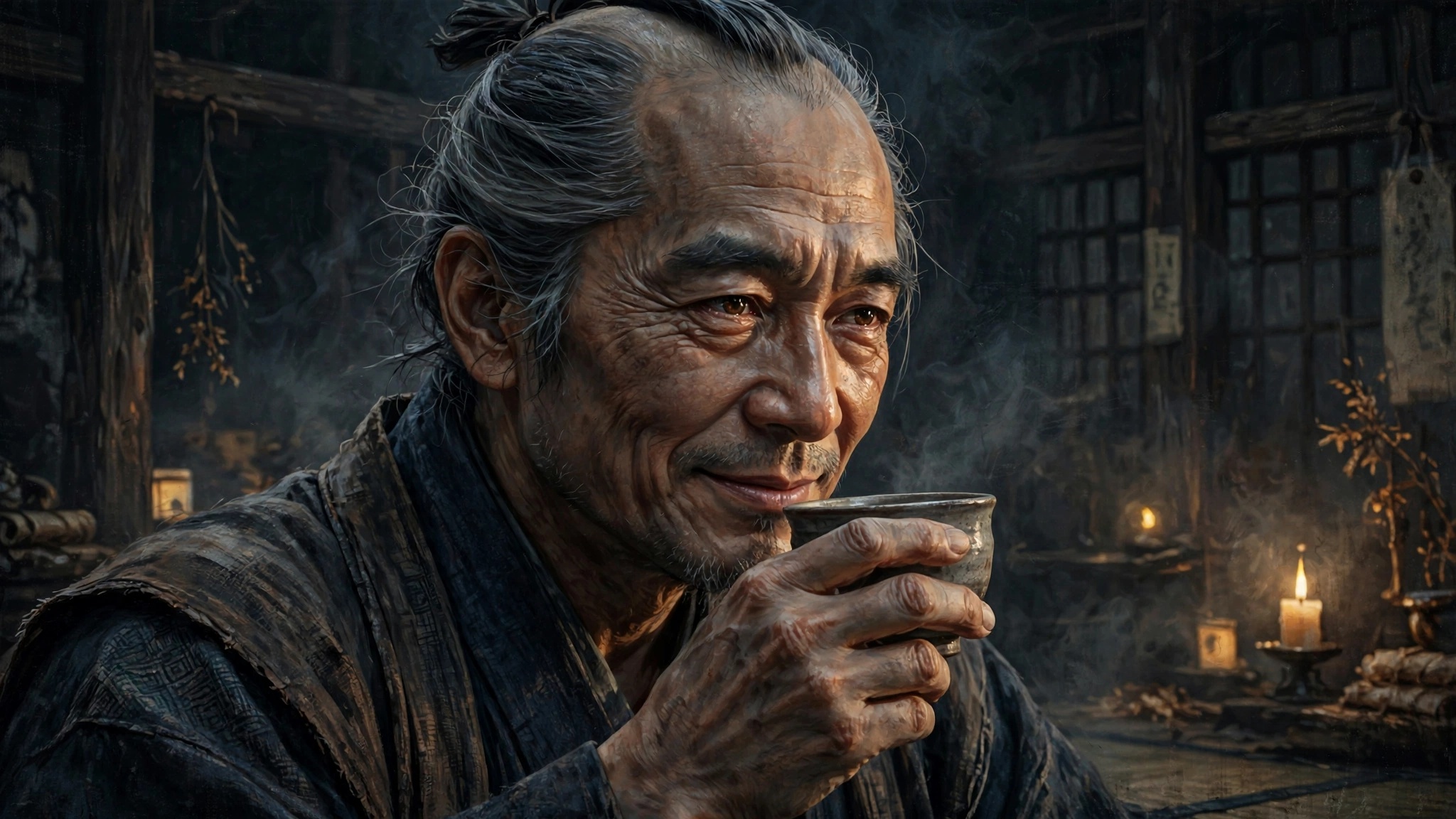 The Shinohara master’s face, a contented smile playing on his lips, his eyes gleaming with satisfaction.
South of the falls once stood the farming household of Shinohara. Its master was, by every surviving account, an unusually gifted marksman — a farmer by necessity, a hunter by inclination, who spent whatever hours the fields could spare moving ridge to ridge with his matchlock gun. He had taken bear from these mountains, and deer, and the occasional boar that strayed too near the terraced fields below. He had never taken anything like what rose from kurogane iwa on the morning this story turns on.
The creature that emerged from the hollow was, in the words preserved by the telling, a back “like the trunk of a pine,” black and wet, catching the thin canopy light in a dull, oily shine. No measurement survives. The account insists only that the body seemed to continue without a clear end — a detail that, in Japanese serpent lore more broadly, often matters more than any number would. Length unspecified is length unlimited; the imagination is left to do what measurement cannot.
The hunter’s first thought, preserved almost word for word in the record, was not fear. It was pride — the simple, human wish that the village could see what he was about to do. He closed the distance along the wet rock, steadied his aim, and lit the fuse. The report filled the ravine; the body fell back into the pool; and by evening the skin was stretched on bamboo poles in the Shinohara yard for all of Ochi to admire.
Pride, Drink, and the Blue Fire in the Yard
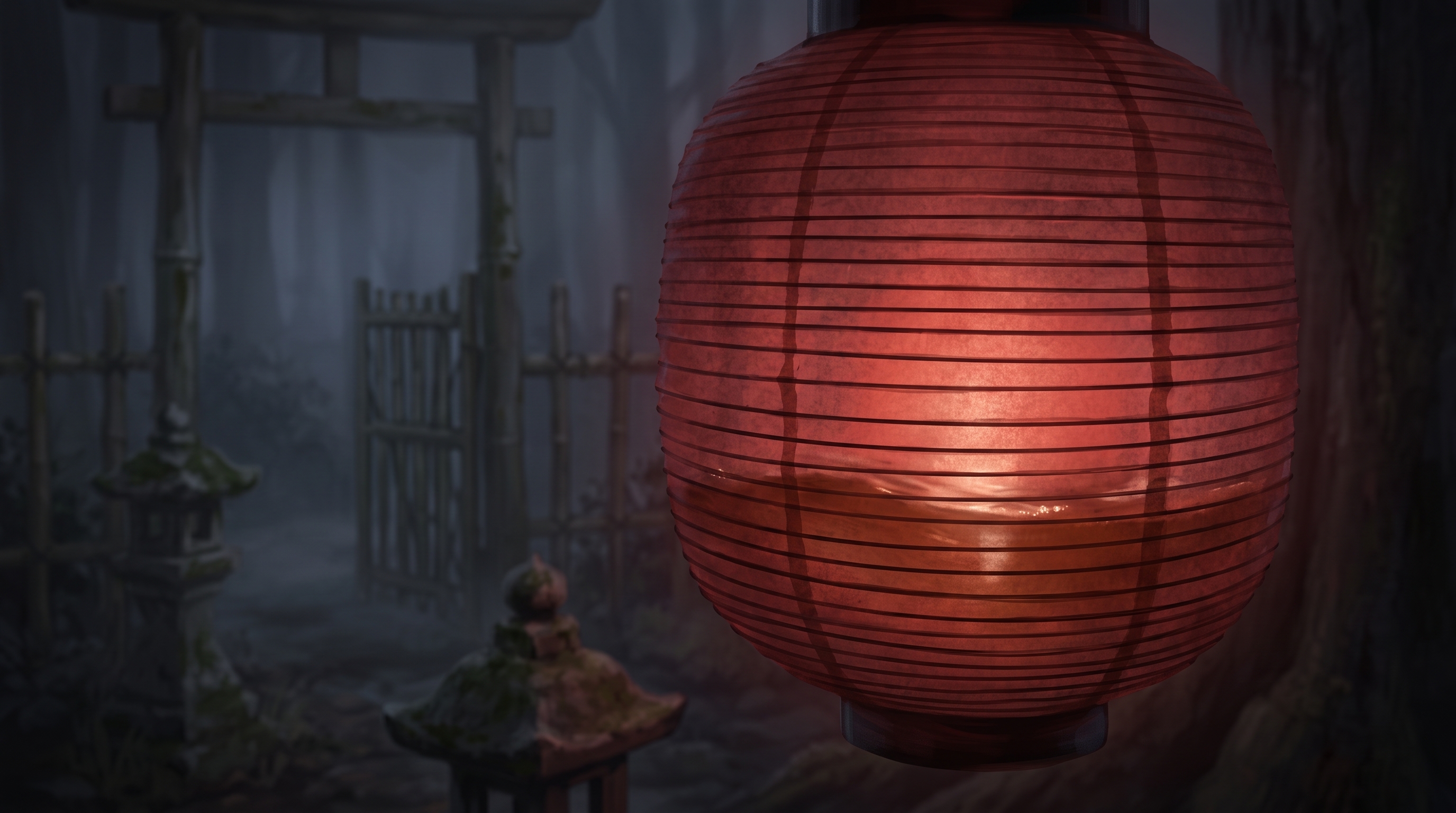
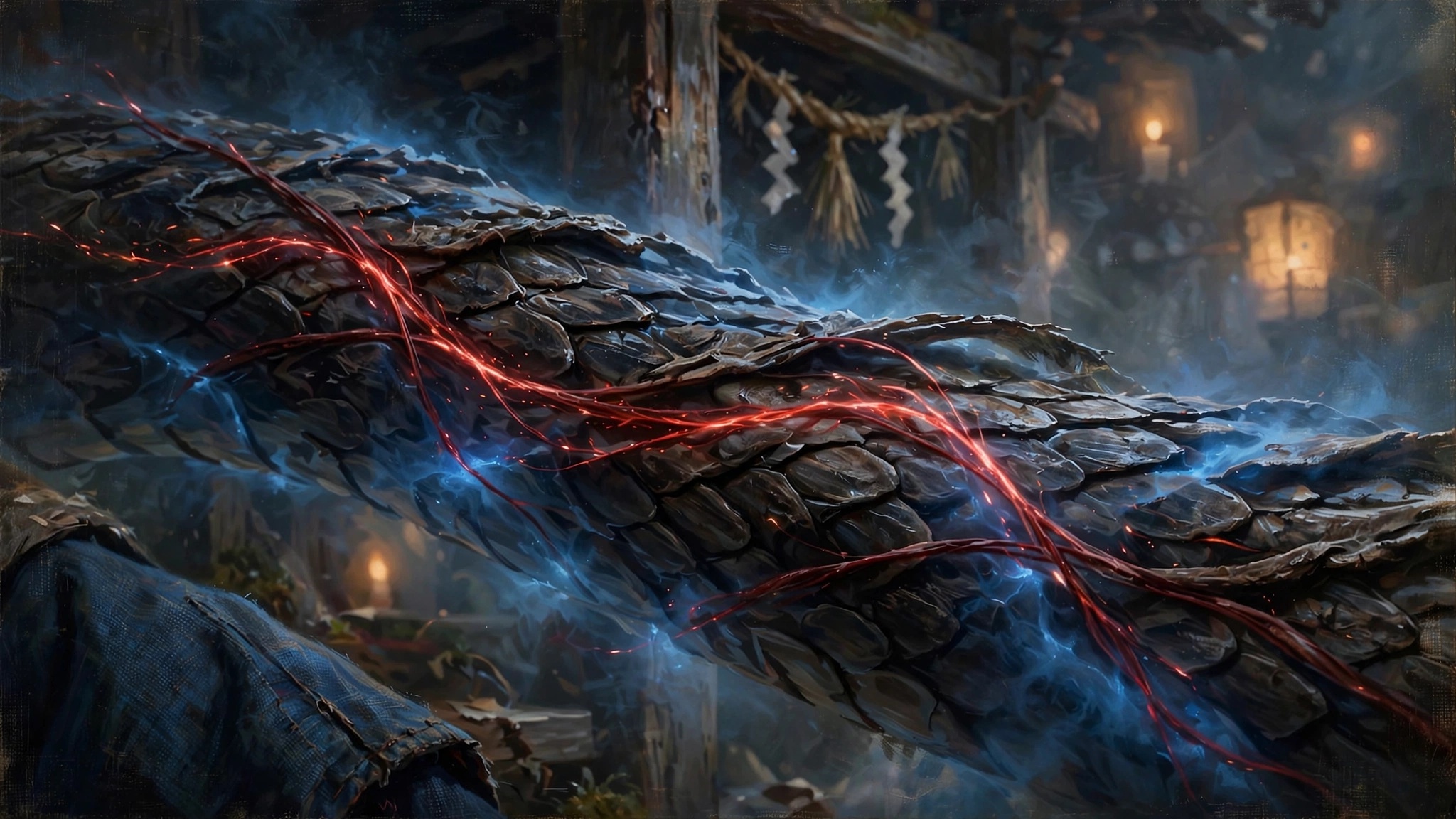 Flickering Red Threads.
That night, the master of the house invited several neighbors in to drink, among them the relative who had helped skin the serpent at the water’s edge. The talk turned, as it always does in these stories, entirely to the kill. One guest admitted he had never believed the old stories of the falls’ size until he saw the pool himself, filled edge to edge with coiled black body. Another called it a tale fit for grandchildren. A third praised the hunter’s nerve — “iron,” he said, “all the way through” — and the hunter laughed, lifting his cup to meet their eyes.
It was in that instant, the account says, that a black flash crossed his vision and he fell backward where he sat. What followed had no translation worth offering: a single syllable of pain, are, are, are, repeated as he rolled across the floor while his neighbors tried and failed to hold him still. The fit eventually passed. He was carried to bed. The guests left without once saying the word “serpent” aloud — as though naming it might finish whatever had already begun.
Outside, under a sky with no stars and no moon, every pair of eyes kept drifting back to the hide still strung between the trees. Wind moved through the branches in sharp, nervous gusts. Then the hide began to brighten — a pale blue light, two threads of red flickering across it like a tongue — until the skin itself became, entirely, fire, lifting whole into the air above the yard and drifting toward the roof. The men dropped to the ground. The house burned completely, and at the height of the blaze the upper half of the fire gathered itself into a single ball and flew back across the ravine, toward Taru no Taki.
The Curse That Outlived the House
Every member of the Shinohara household died that night. Not one survived the fire. The oral tradition does not record what became of the relative who had helped with the skinning, though those who still tell the story in Ochi generally assume his fate was no gentler than the rest.
What followed in the years after is, in some ways, the more unsettling half of the account. Whenever a descendant of Shinohara blood approached the falls, a fog would rise without warning — thick enough to erase all direction — and the person would lose their footing in it and fall. The record states, flatly, that every one of them died this way. No exceptions survive in the telling.
Local residents today, according to the account, will say — without elaboration, as though the matter requires none — that no one of the Shinohara line can go near the great falls. They do not explain why. They simply say it, and look toward the sound of the water, falling and falling into a black pool no one from that family has approached in a very long time.
Historical Legacy & Archival Footnotes
Serpent’s Grudge: The Hunter of Taru Falls belongs to a category of Japanese kaidan that never passed through a single famous compiler’s hand — it survives instead in the regional oral record of Kōchi Prefecture, the kind of localized minwa (village legend) long gathered into prefectural folklore surveys and legend compendia such as the multi-volume Nihon Densetsu Taikei, which catalogs exactly this species of place-bound grudge tale. Unlike the literary kaidan shaped deliberately for print — Asai Ryōi’s Otogi Bōko (1666) or Ueda Akinari’s Ugetsu Monogatari (1776) — this is a story that stayed close to the ground it happened on, told by people who could point to the pool in question.
Its closest literary cousin is arguably Akinari’s “Jasei no In” (“The Lust of the White Serpent”) in Ugetsu Monogatari, which likewise treats the serpent not as a monster to be simply defeated but as a being whose nature — patient, proprietary, and ultimately vengeful — outlasts the human who provokes it. The Shinohara tale shares that structure exactly: the kill is easy, almost trivial; the reckoning is what takes a lifetime, and in this case several lifetimes, to complete. This is historical interpretation rather than documented influence — nothing in the Ochi oral record claims Akinari as a source — but the kinship in theme is difficult to miss.
What remains today is modest and, in its way, more convincing than any manuscript. Taru no Taki still falls in the mountains above Ochi with the same unbroken tōtō thunder the villagers have always described. Yokogura still rises across the ravine, still carries whatever remains of an emperor drowned eight centuries ago. And residents of the district, when asked, still decline to explain why a particular family name is kept away from a particular waterfall — which is, in the end, the oldest and least literary form a kaidan can take: not a text, but a standing instruction, quietly obeyed.
Primary Texts & Scholarly References
- Oral folklore of Takaoka District, Kōchi Prefecture, as preserved in regional minwa (village legend) tradition surrounding Ochi village and Taru no Taki.
- Nihon Densetsu Taikei (日本伝説大系), regional legend compendium series documenting place-bound grudge and serpent tales across Japanese prefectures.
- Ueda Akinari (1776), Ugetsu Monogatari, particularly “Jasei no In” (“The Lust of the White Serpent”), for comparative structure of serpent-grudge narratives.
- Asai Ryōi (1666), Otogi Bōko, as foundational reference for the literary kaidan tradition against which oral legends are often contrasted.
- Yanagita Kunio (1910), Tōno Monogatari, as methodological precedent for the recording of remote, orally transmitted village folklore in Japan.
Soundtrack & Audio Credits
Music: ‘Glassplitter’ by Kraosando (https://kraosando.bandcamp.com) — Licensed under CC BY 4.0