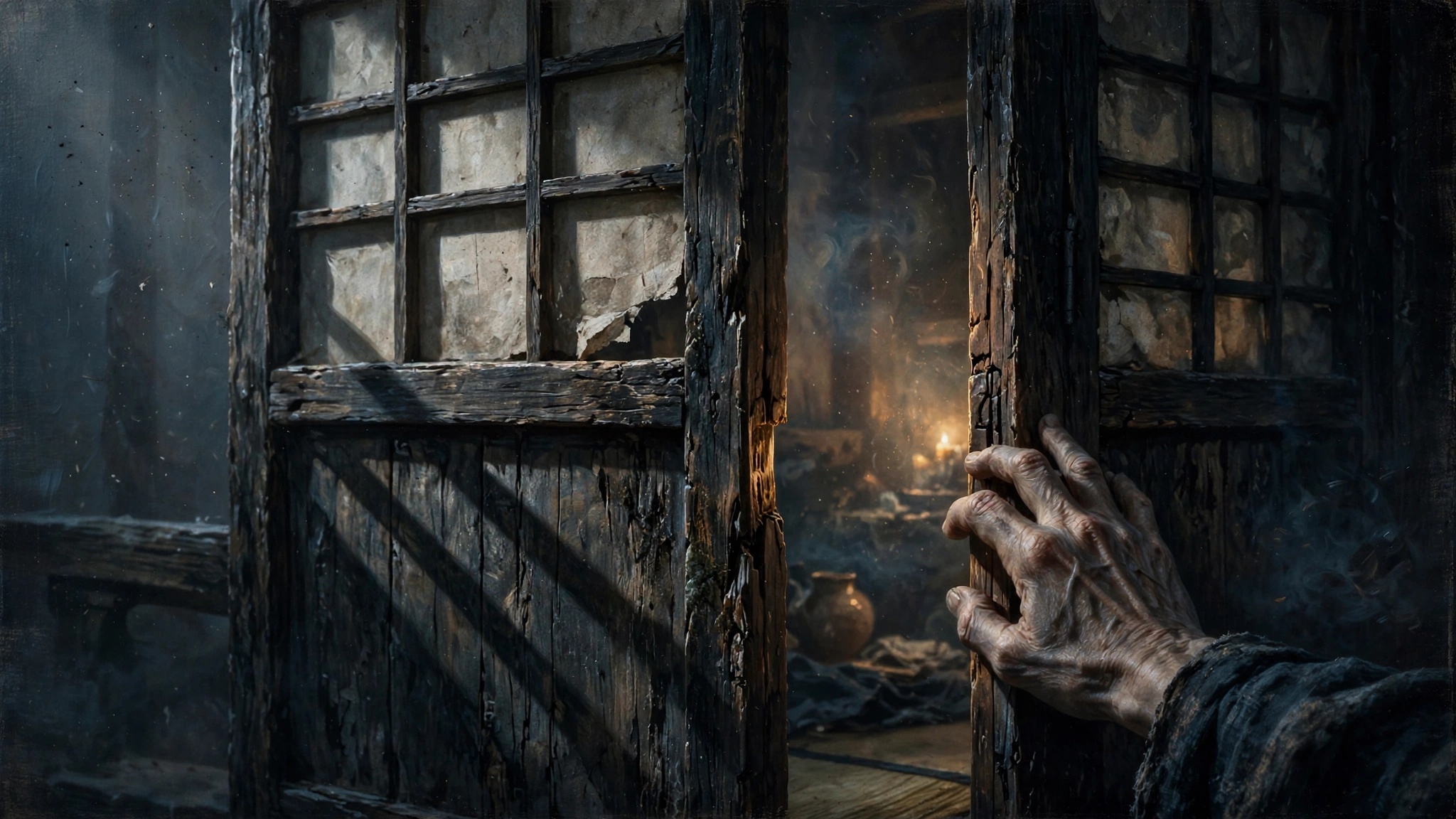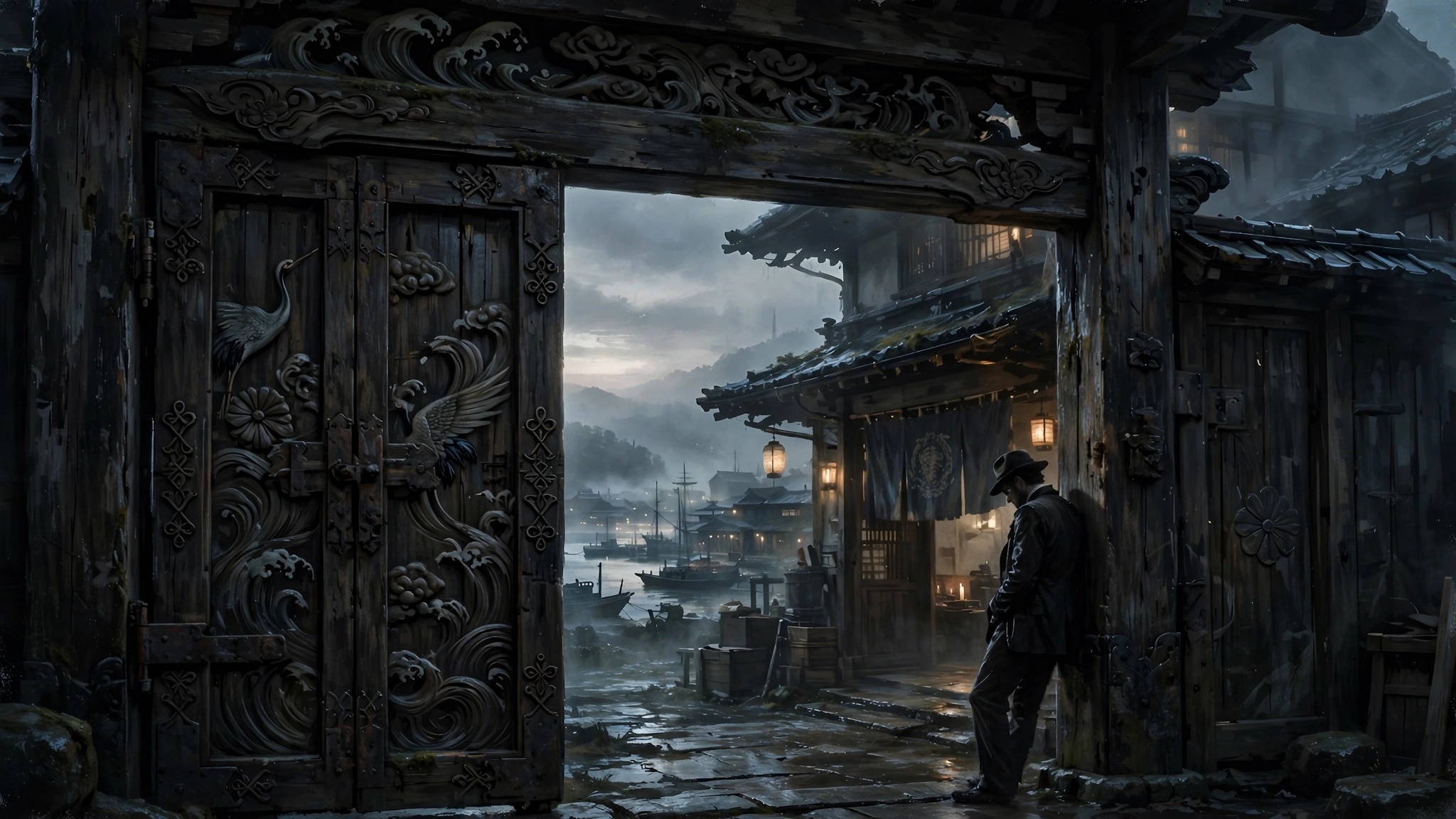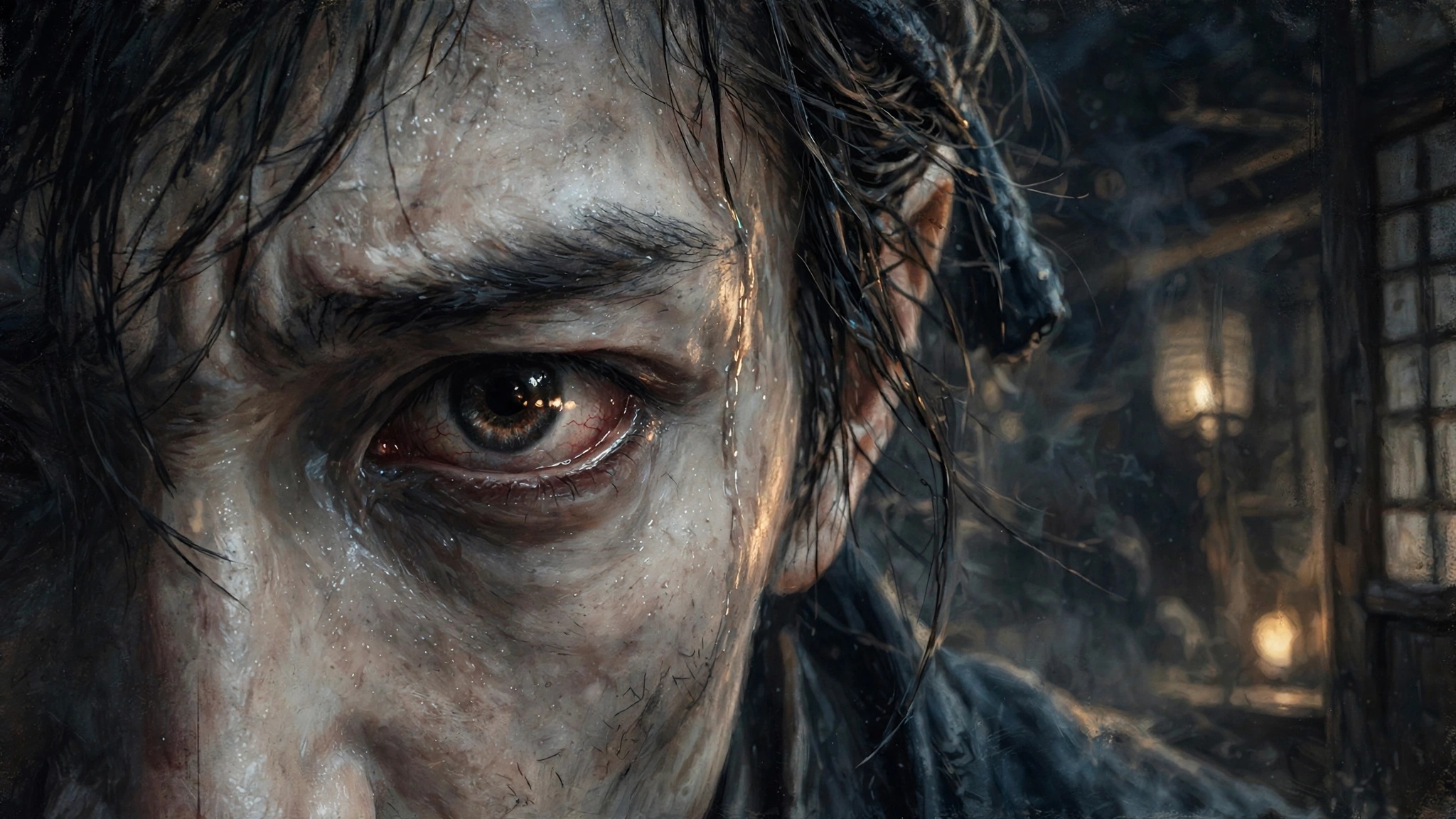

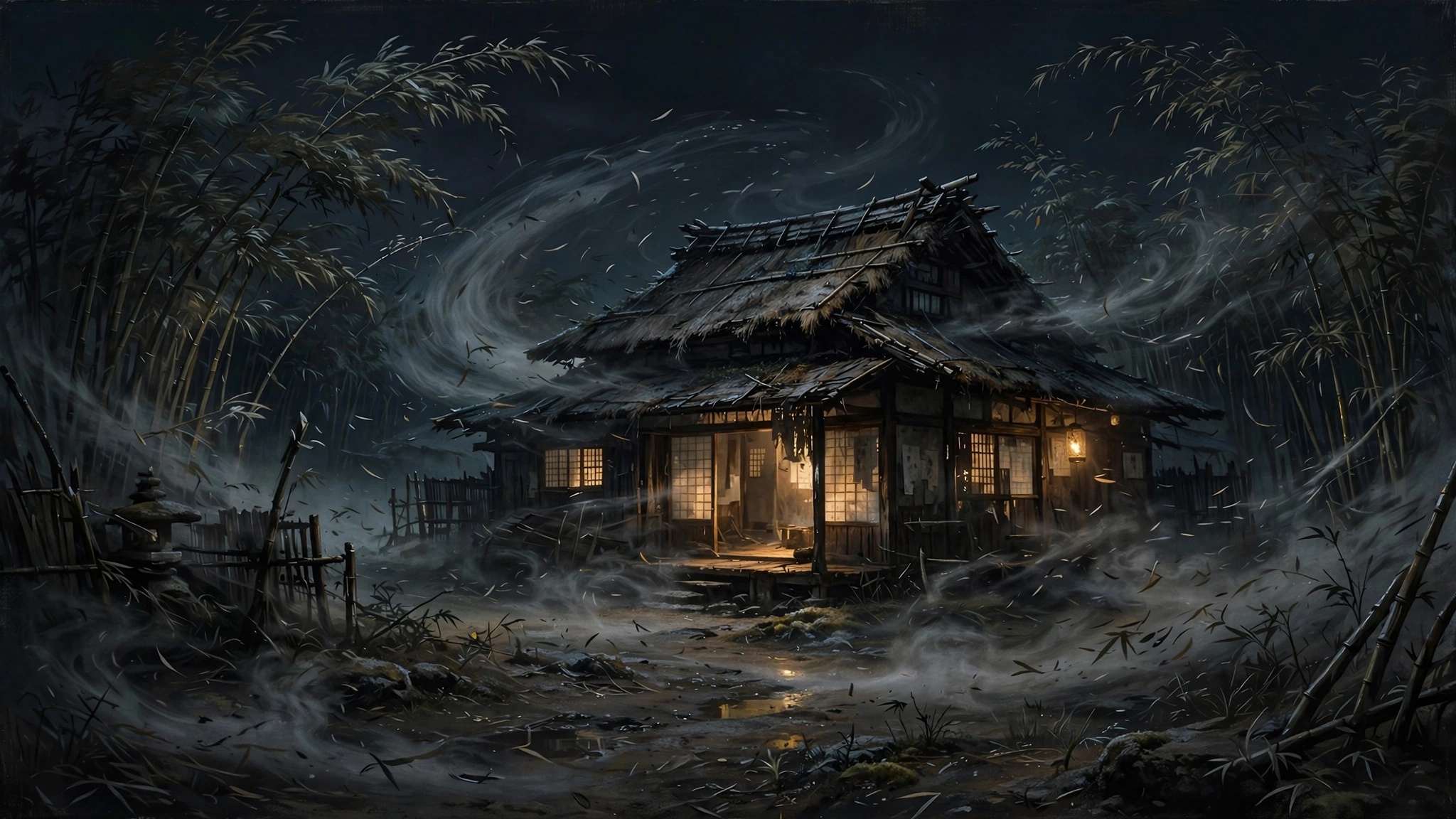
The bar across the door had not moved. The screens had not torn. And still, by morning, the wife of a garrison officer named Ōyō Kotsu was gone from a room with no visible way out. This is the seed from which “The Demon That Stole Beauties” grows — a story old enough that its earliest tellers did not think to explain how a locked room could be emptied without a mark left behind. They simply recorded that it was so.
A Tale Older Than the Word Kaidan
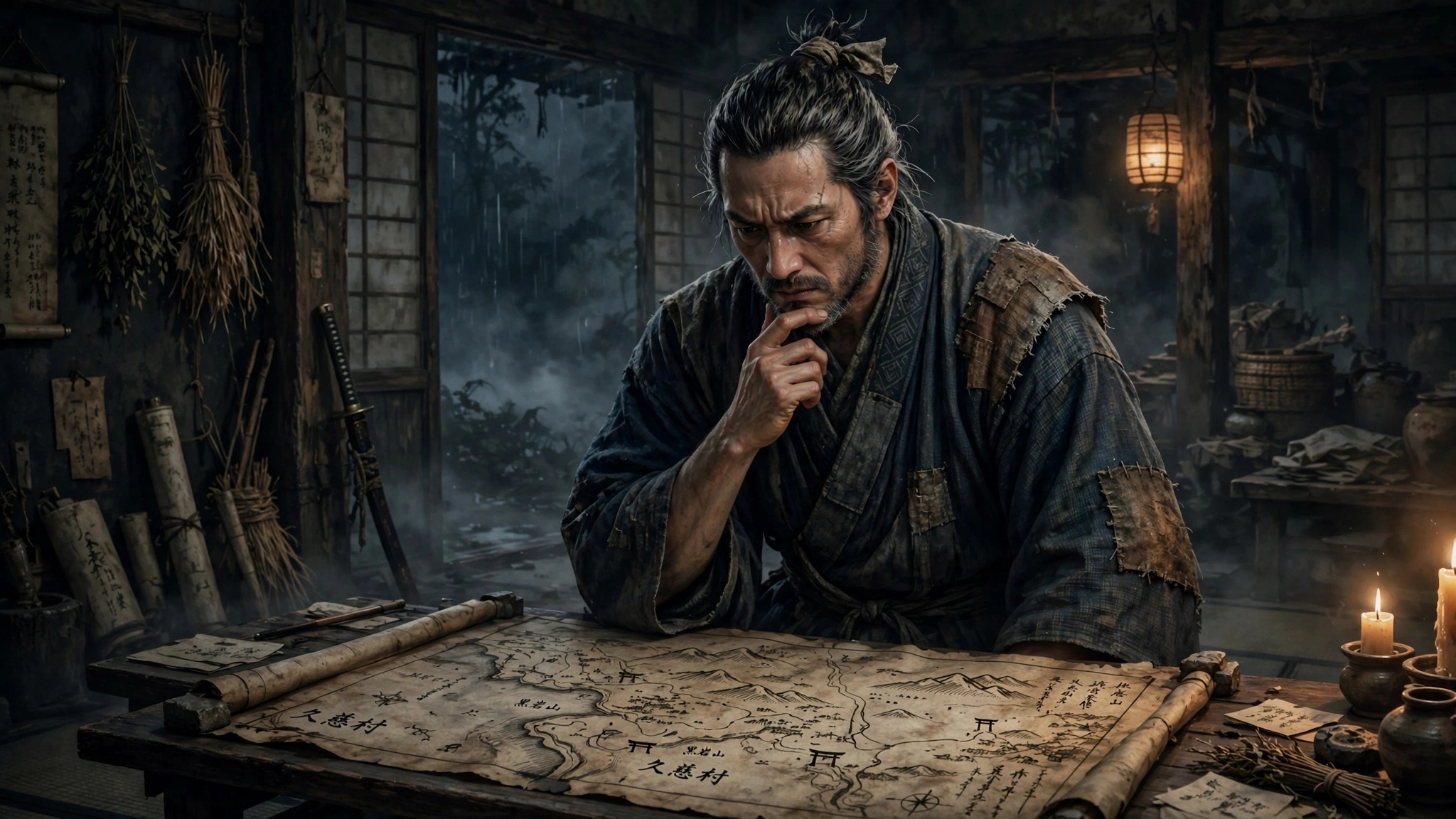 Officer’s Thoughtful Demeanor.
Long before the word kaidan described a genre of sitting-room ghost recitation in Edo-period Japan, stories like this one circulated on the Asian continent as zhiguai — “accounts of the strange.” The term belongs to a Chinese literary tradition stretching back to the Six Dynasties period, when scholars and minor officials compiled brief, almost documentary records of ghosts, spirits, and anomalies, often presenting them with the flat tone of a magistrate’s report rather than a storyteller’s flourish. The tale of Ōyō Kotsu belongs to this lineage, dated by its own internal account to the final years of the Datong era of the Liang dynasty — the mid-sixth century.
What makes the story notable, and what justifies its place in a Japanese kaidan companion piece, is not that it originated in Japan. It did not. It is notable because of what happened to stories like it afterward — how they crossed the sea, were recopied by Buddhist monks and literary scholars, and absorbed into the broader East Asian repertoire of supernatural literature that Japanese compilers drew upon when they built their own kaidan anthologies centuries later. The demon of Chōraku is, in this sense, an immigrant story. It arrived in Japan already old.
The Garrison at the Edge of the Mountains
 Climbing Handholds on Rock.
The record places Ōyō Kotsu in the southern frontier, near a garrison town called Chōraku, sent to suppress unrest among the local population and unusually accompanied by his wife — a woman the account describes with a single vivid phrase, skin pale as snow, a face that drew attention without effort. Before the unit had even finished settling its encampment, a local resident warned him plainly: a demon-spirit haunted these hills, and it took beautiful women wherever it found them. Ōyō Kotsu posted guards. He assigned more than ten attendant women to watch his wife through the night. It was not enough.
On the second night the wind rose, strange for the season and for no particular hour, and in its wake the household’s vigilance simply gave out — every guard, every attendant, fell into a sleep too deep for duty. When Ōyō Kotsu woke, his wife was gone from beside him, the door still barred exactly as he had left it at dusk. There was no broken seal, no disturbed latch, nothing a person could point to as an entrance or exit. He searched the surrounding hills for a full day and found nothing. He swore, there in the dark, that he would not return north without her.
Into the White Ape’s Mountain
 Bound Resistance.
What followed was not a rescue mounted in anger but a methodical, almost bureaucratic search — Ōyō Kotsu sent word that he had fallen ill, bought himself time his superiors had not granted, and spent a month combing ravines and dry riverbeds before finding a single shoe, hers, roughly a hundred li from the garrison. He gathered thirty of his best soldiers and pushed another two hundred li deeper into terrain the local guides refused to enter. Ten days later, near a peak half-swallowed by cloud, the party heard something that should not have belonged to that landscape at all: women laughing.
Beneath trees in blossom at an altitude where nothing should have bloomed, the soldiers found dozens of women — some taken as recently as a season past, one held for ten years — living in a kind of suspended captivity. Ōyō Kotsu’s wife, found among them and unwell, did not rise to greet him. She waved him back and told him to leave before the thing returned. What the women explained next reads less like legend and more like an operations manual: fine wine, ten dogs, several tens of catties of hemp fiber, timed to an exact day, with the whole plan held together by patience rather than force.
The One Place a Blade Could Find Purchase
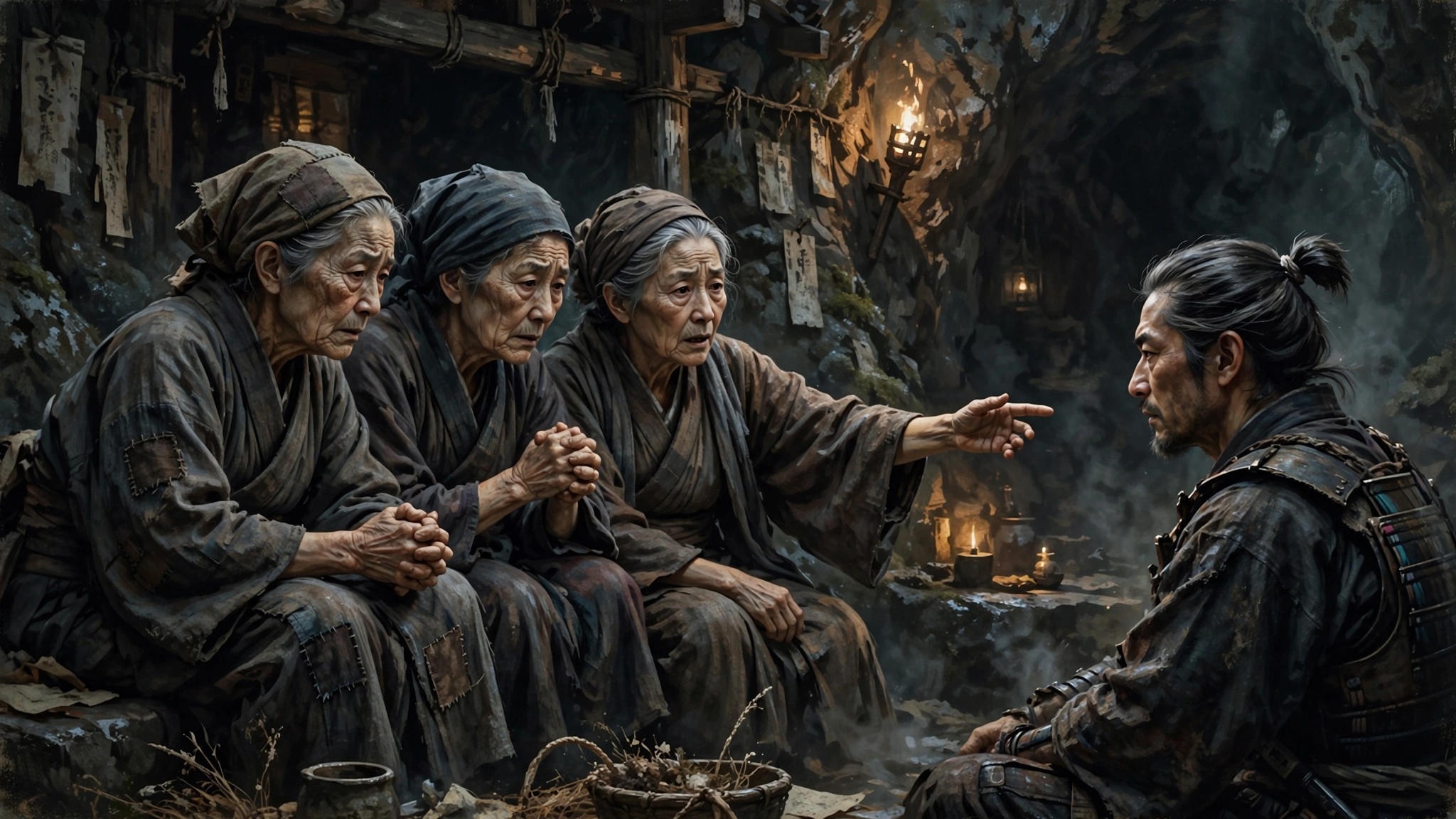 Whispers of the Past.
What the women described, when it finally appeared, was a bearded man in white robes, handsome, carrying a staff — a shape that only became what it truly was once wine and silk had done their work. It devoured the dogs with evident relish, drank itself into stupor on measure after measure of wine, and let itself be led, laughing, back into the cave. There the soldiers found it bound by its own limbs: a great white ape, eyes burning, straining against silk its captors had been told, correctly, would shatter in a single layer but hold in three, twisted through with hemp.
Swords turned aside everywhere on its body except one point — a narrow span below the navel, the single place the creature had always kept covered out of what the women called its own habit of hiding. It was the detail that decided everything. Ōyō Kotsu drove his blade there, and the demon, dying, spoke a prophecy almost gently: that his wife already carried a child, that the child should not be killed when born, that it would one day serve a worthy ruler and raise up a household of its own.
A Prophecy Kept, A Father Condemned
The soldiers recovered a hoard of plundered wealth and thirty captive women, each eventually returned to whatever family still waited. The following year, Ōyō Kotsu’s wife gave birth to a son whose features, the record states without embellishment, resembled an ape’s. Soon afterward the Liang dynasty collapsed; under the succeeding Chen dynasty, Emperor Wu had Ōyō Kotsu executed, and a retainer named Kō Sō took the boy in secret, raising him as his own. The child grew into exactly what the dying demon foretold — quick-minded, restless, eventually a man of letters whose writing carried his family’s name forward.
Scholars of Chinese literature have long noted that this is almost certainly not a neutral account. The tale survives in Chinese collections under the title Bai Yuan Zhuan — “The Tale of the White Ape” — and its ending points, with some precision, toward Ouyang Xun, the celebrated Tang-dynasty calligrapher, whose father bore a name close enough to Ōyō Kotsu’s to suggest deliberate implication. Many historians read the whole demon narrative as political slander dressed as zhiguai record — a vicious joke about a rival’s parentage, wearing the costume of the supernatural. That reading belongs to historical interpretation, not to the text itself, but it deserves stating plainly.
Historical Legacy & Archival Footnotes
How a sixth-century continental slander became source material for a channel built on Japanese folklore says something about how kaidan itself was assembled. Edo-period compilers rarely invented their material from nothing. Asai Ryōi, whose 1666 anthology Otogi Bōko stands among the foundational texts of the genre, built much of his collection by translating and relocating Chinese Ming-dynasty vernacular ghost stories — most famously drawing on Jiandeng Xinhua — into Japanese settings and sensibilities. The demon of Chōraku belongs to exactly the kind of continental material that practice absorbed, even where no single surviving Edo text names this tale directly.
Japan also developed its own parallel creature that echoes the white ape almost exactly. Toriyama Sekien, the Edo-period artist and yokai cataloguer, recorded the hihi in his 1781 bestiary Konjaku Hyakki Shūi — a massive, mountain-dwelling ape-spirit said to abduct women from remote villages, immensely strong, difficult to kill by ordinary means. Whether the hihi descends directly from stories like Ōyō Kotsu’s or arose independently from shared continental and indigenous fears of the deep mountain forest, the resemblance is not coincidence. It reflects a pattern folklorists recognize across East Asian supernatural literature: the abducting ape-demon, bound to remote peaks, feeding on beauty and dogs in equal measure.
No cave answering to this story’s description has ever been identified, and the record itself says as much — no one, as far as it states, went looking again. What remains is the structure of the telling: a locked room emptied without a mark, a wife’s voice warning her husband back rather than toward safety, and a dying creature’s prophecy that came true in every particular, spoken by the one voice with the least claim to be believed.
Lafcadio Hearn, writing centuries later for readers who knew nothing of zhiguai or hihi, called this quality of Japanese and East Asian ghost literature its strange sobriety — horror delivered in the voice of a clerk, not a poet, which is precisely what makes it endure.
Primary Texts & Scholarly References
- Anonymous (Tang dynasty compilation of a Six Dynasties-era account), Bai Yuan Zhuan (白猿傳, “The Tale of the White Ape”), preserved within later Chinese miscellanies such as the Taiping Guangji (10th century).
- Asai Ryōi (1666), Otogi Bōko — foundational Edo-period kaidan anthology built substantially on translated Chinese vernacular ghost tales.
- Toriyama Sekien (1781), Konjaku Hyakki Shūi — early catalogue of the hihi, a mountain ape-yokai associated with the abduction of women.
- Ueda Akinari (1776), Ugetsu Monogatari — comparative example of continental Chinese source material reworked into Japanese ghost literature.
- Lafcadio Hearn (1904), Kwaidan: Stories and Studies of Strange Things — early English-language framing of the Japanese kaidan tradition for Western readers.
- National Diet Library digital collections — holdings of Edo-period kaidan manuscripts and related zhiguai-derived miscellanies (consulted for background context).
Soundtrack & Audio Credits
Music: ‘Bajuschki Baju’ by Kraosando (https://kraosando.bandcamp.com) — Licensed under CC BY 4.0