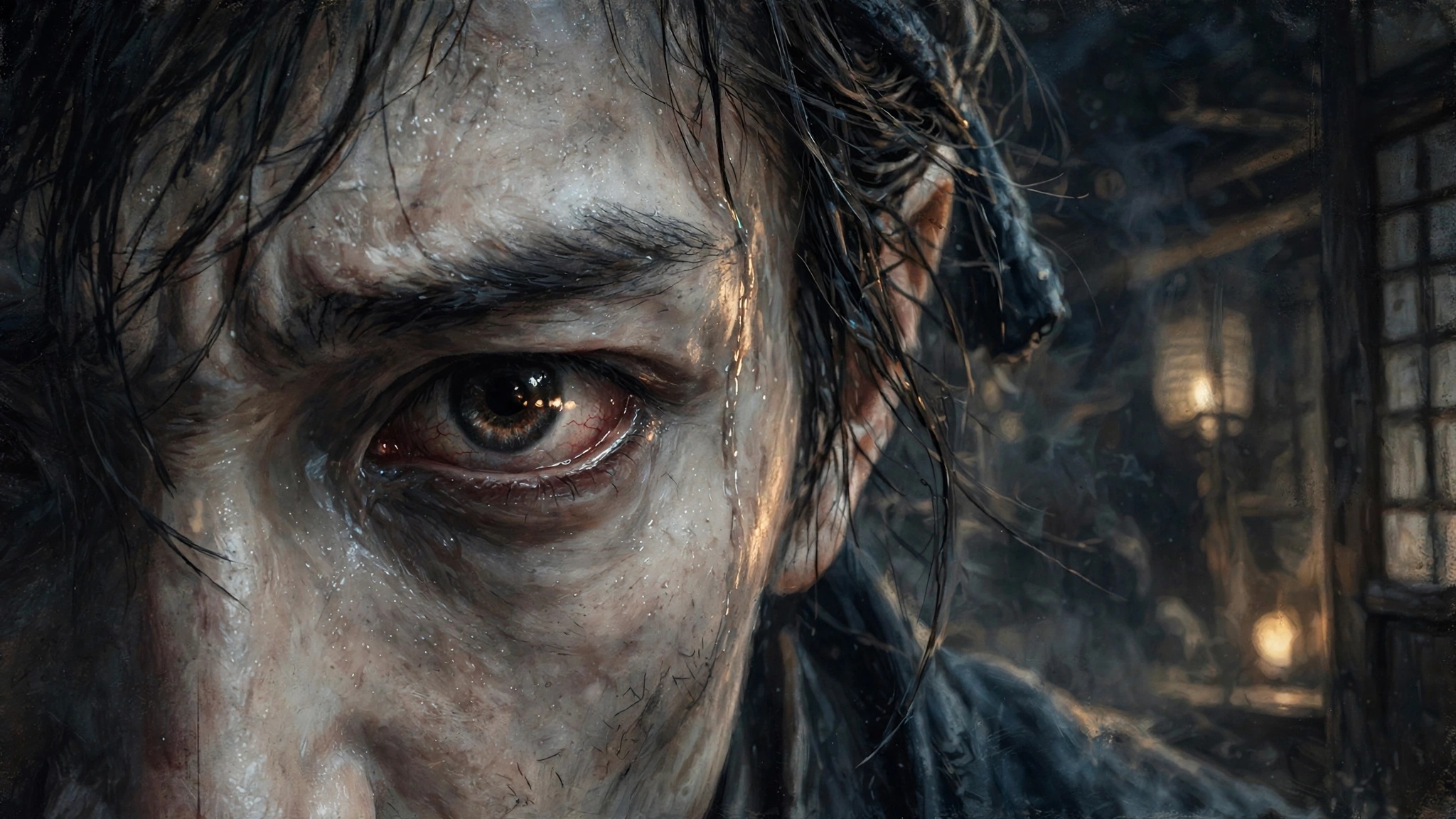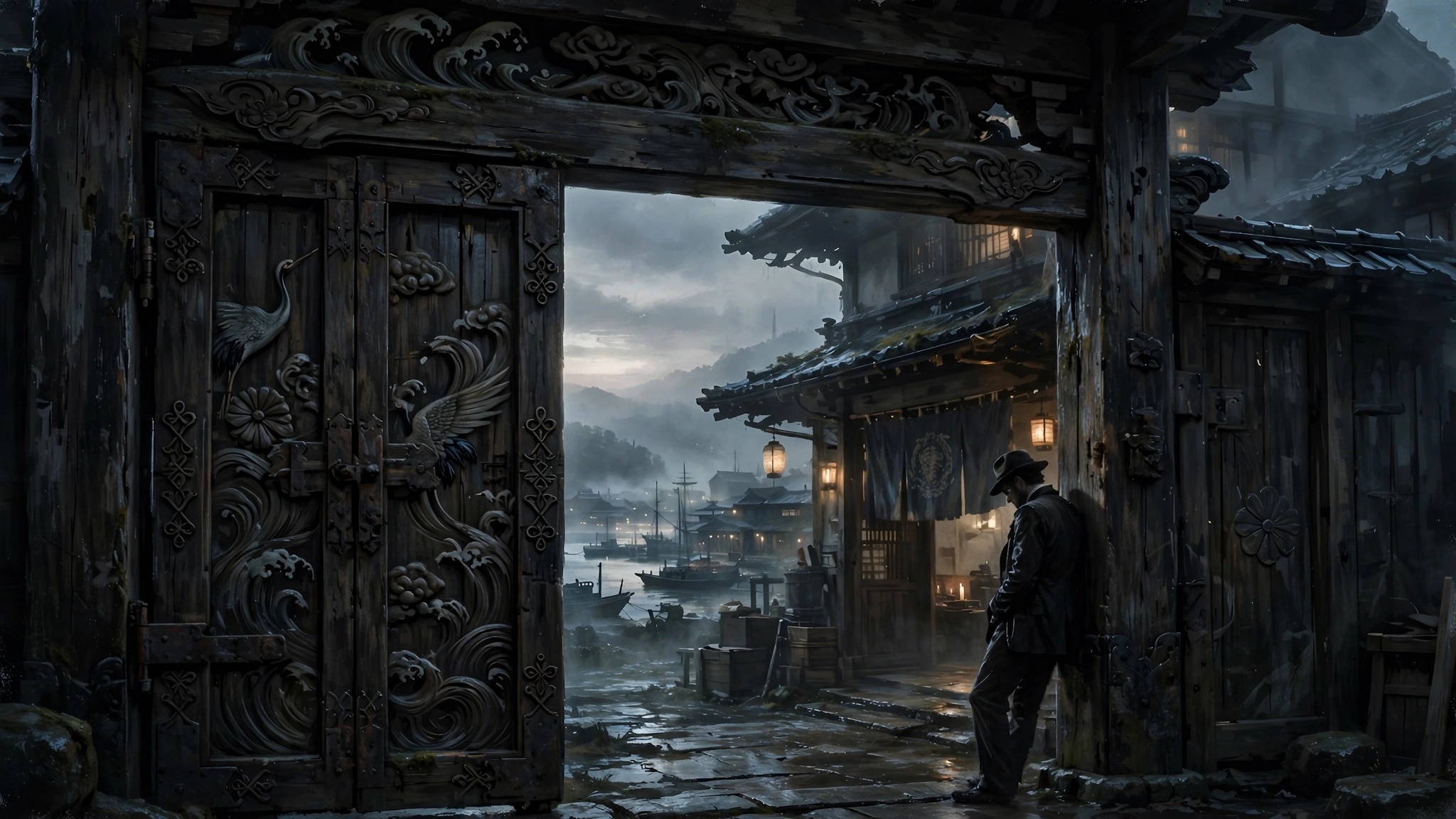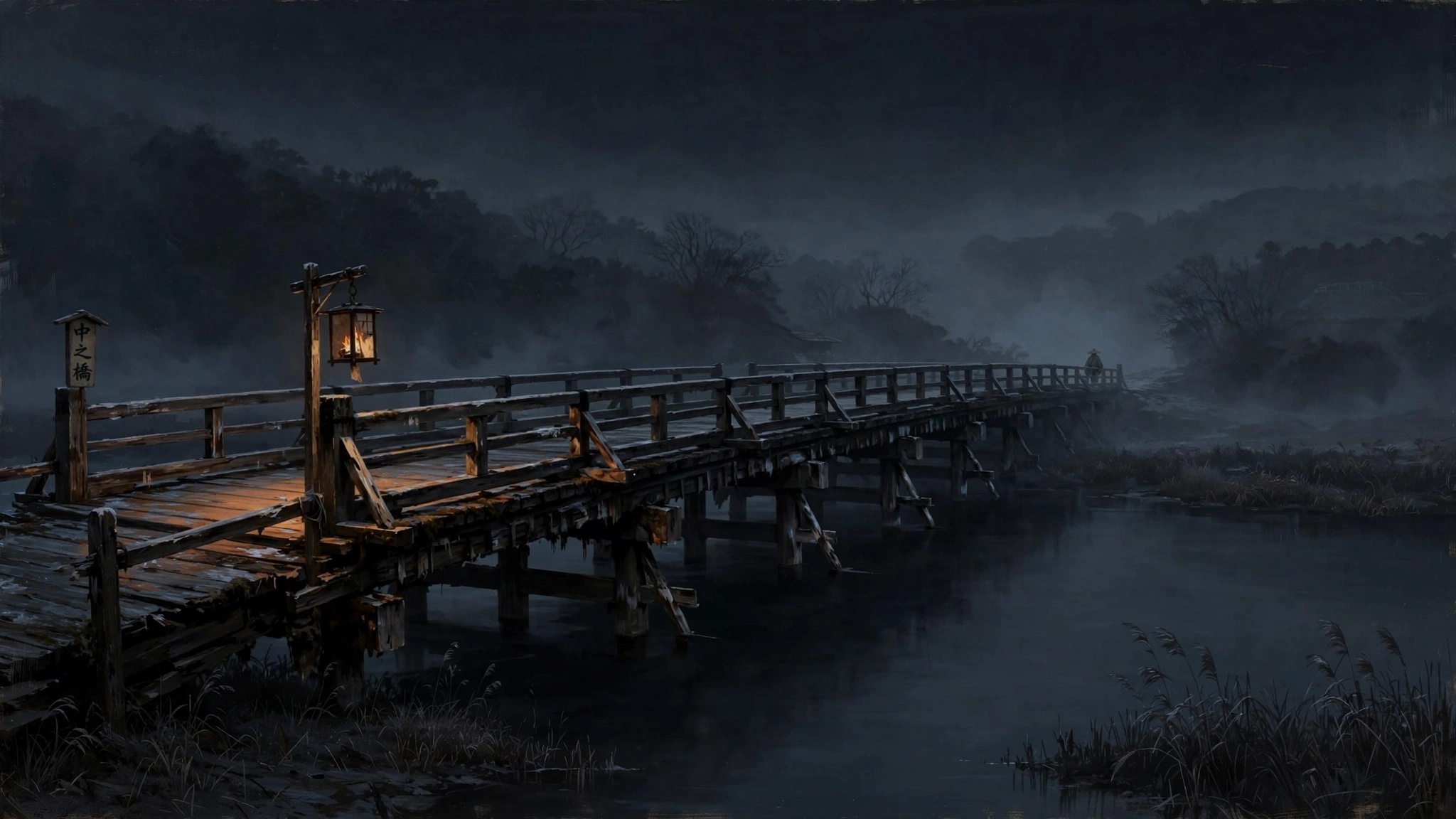

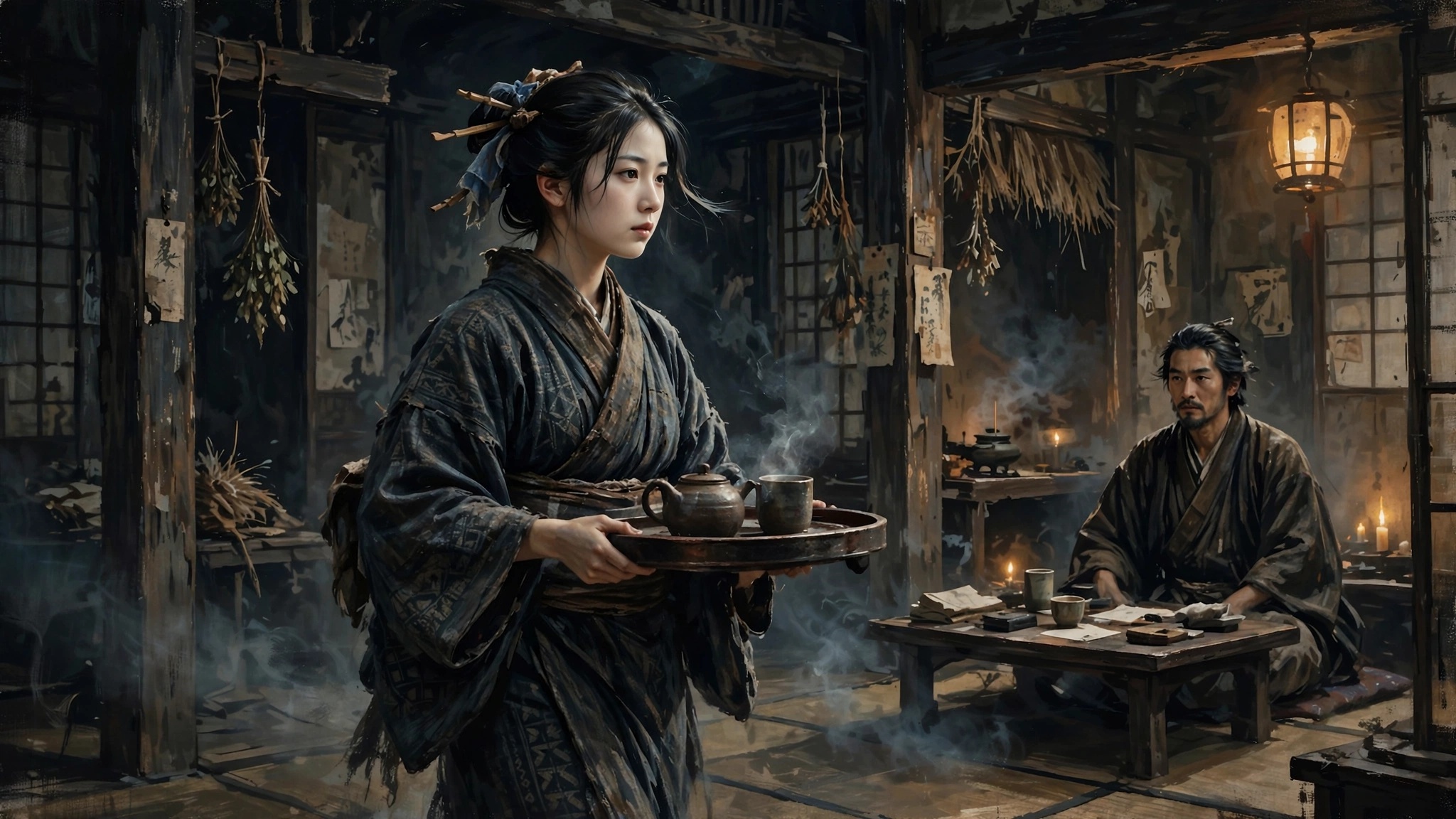
The tea spilled across Nagao Chōsei’s fingers before he noticed it had happened. He was watching a servant girl cross a lamp-lit dining room in the mountain village of Ikaho, and something in the tilt of her chin had reached backward through seventeen years and taken hold of him. The woman at the center of this story is called O-Tei in the English version most readers meet, but the name she carries in the Japanese original is Osada (阿貞, read osada) — the older name, from a 1889 collection of Chinese-style ghost tales written in classical Japanese. Hearn’s rendering changed the name and kept the promise intact. What follows is one of the quieter, more disciplined entries in the literature of Japanese kaidan: no vengeful spirit, no blood on the floorboards, only a vow and the long, patient work of its keeping.
The Girl at the Bedside in Niigata
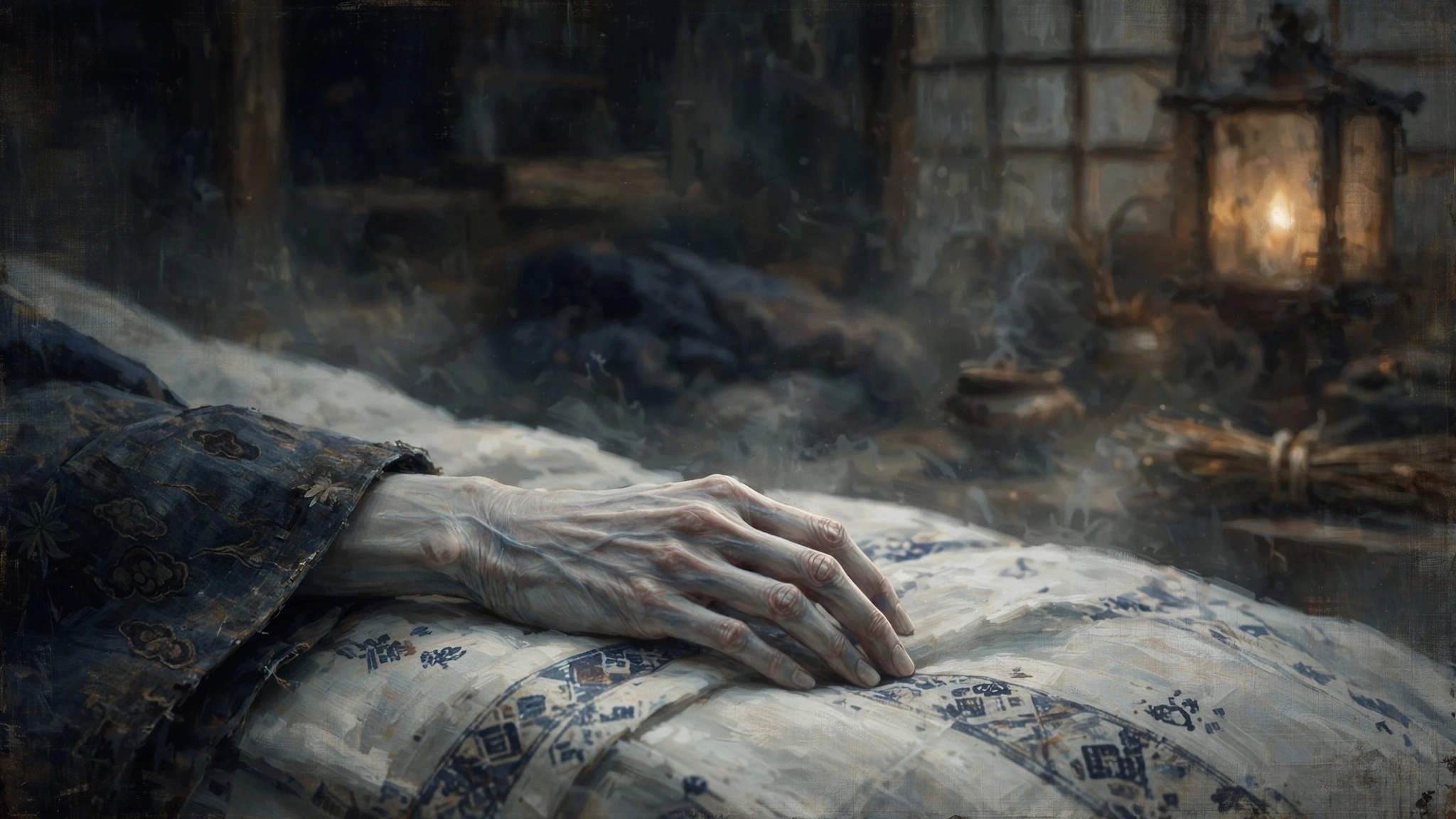 The Hand That Went Still.
The story opens in the town of Niigata, in the province the old records call Echigo. Nagao was the son of a physician, trained for his father’s profession, and betrothed from early childhood to O-Tei, the daughter of one of his father’s closest friends — an arrangement both families treated as settled long before any wedding could take place. Then, in her fifteenth year, her health failed: she was attacked by a fatal consumption, incurable by the medicine of that century.
O-Tei sent for Nagao to bid him farewell. What passed between them at that bedside survived, according to the account, largely because it was written down at all. She told him, calmly, that she was glad to be released from a marriage that had never been fulfilled — an unfit wife, she called herself, too weak for the duties a household would demand. She asked him not to grieve. Then she told him something stranger: she did not believe they were parting forever.
Nagao answered as a devout young man of his era might — that they would meet again in the Pure Land, where sorrow and separation no longer apply. She shook her head. That was not what she meant. Not the Pure Land. This world — his world, the one he would keep living in after she was gone. She told him she intended to be born again as a woman, grow once more to adulthood, and return to him, if he would wait fifteen years. Perhaps sixteen. She reminded him, with something like tenderness, that the husband of her promise was only nineteen.
A Vow Written in a Physician’s Hand
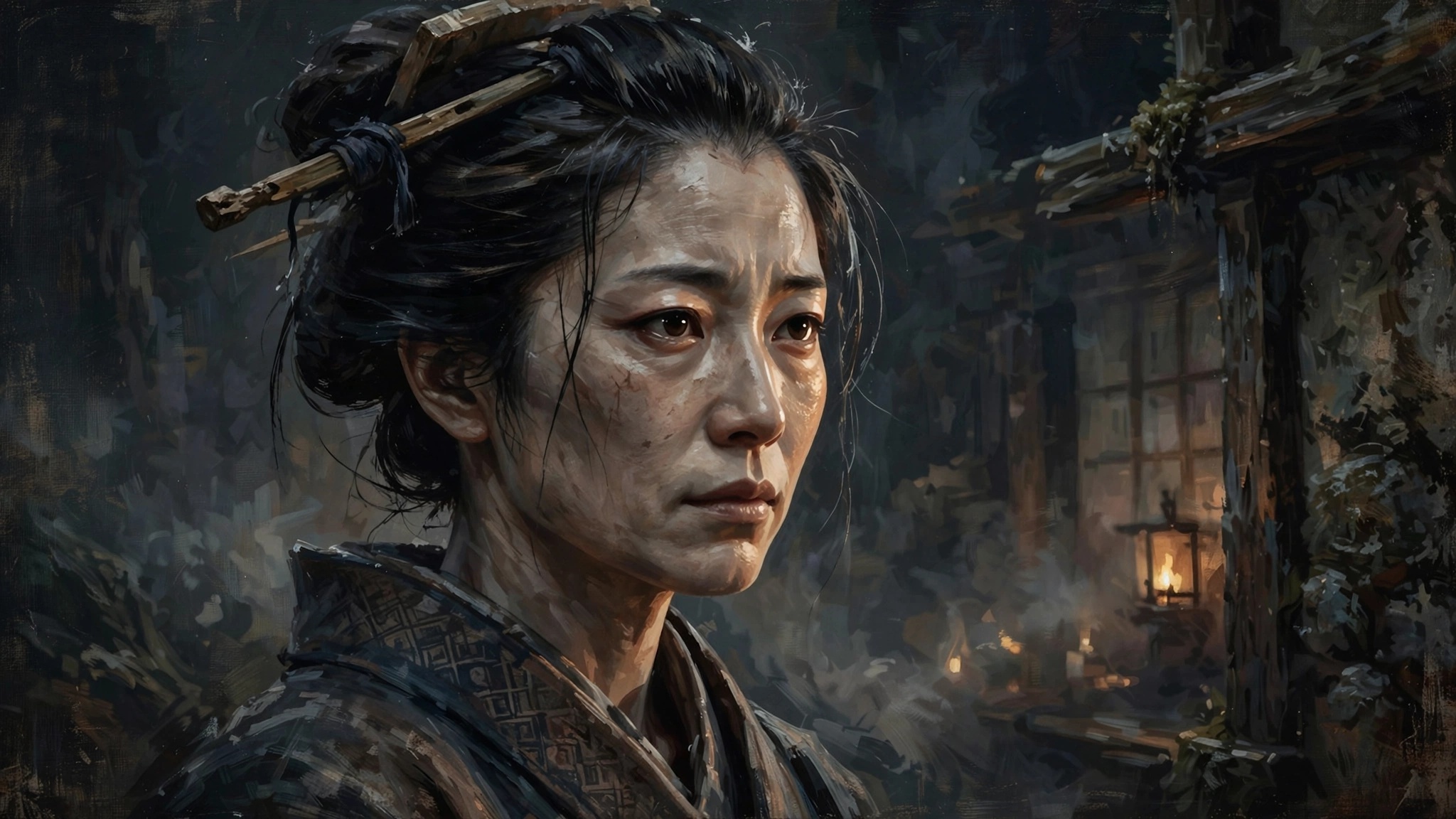 Questioning Gaze.
He promised. He invoked shichishō — the old belief, older than either of their families, that a true marriage binds two people across seven successive rebirths. She asked if he doubted it, and he answered honestly: he feared he would not recognize her, a stranger wearing another woman’s face and carrying another woman’s name. He asked for some mark, some sign he could hold against the uncertainty of waiting.
She told him she could not give one. Only the kami and the Buddhas knew where or how such a reunion might occur. But if he did not refuse her, she said, she would find her way back to him. That was the only thing he needed to remember. Then she closed her eyes, and was gone.
What Nagao did next went beyond the customary grief of the period. He had a memorial tablet carved with her name and set it in the household shrine, making offerings each morning without exception. Then he wrote, in his own hand, a formal vow: that should O-Tei return to him in another woman’s body, he would marry her. He sealed it with his personal seal and placed it, folded, beside her tablet in the household shrine.
Seventeen Years, and a Tray at Ikaho
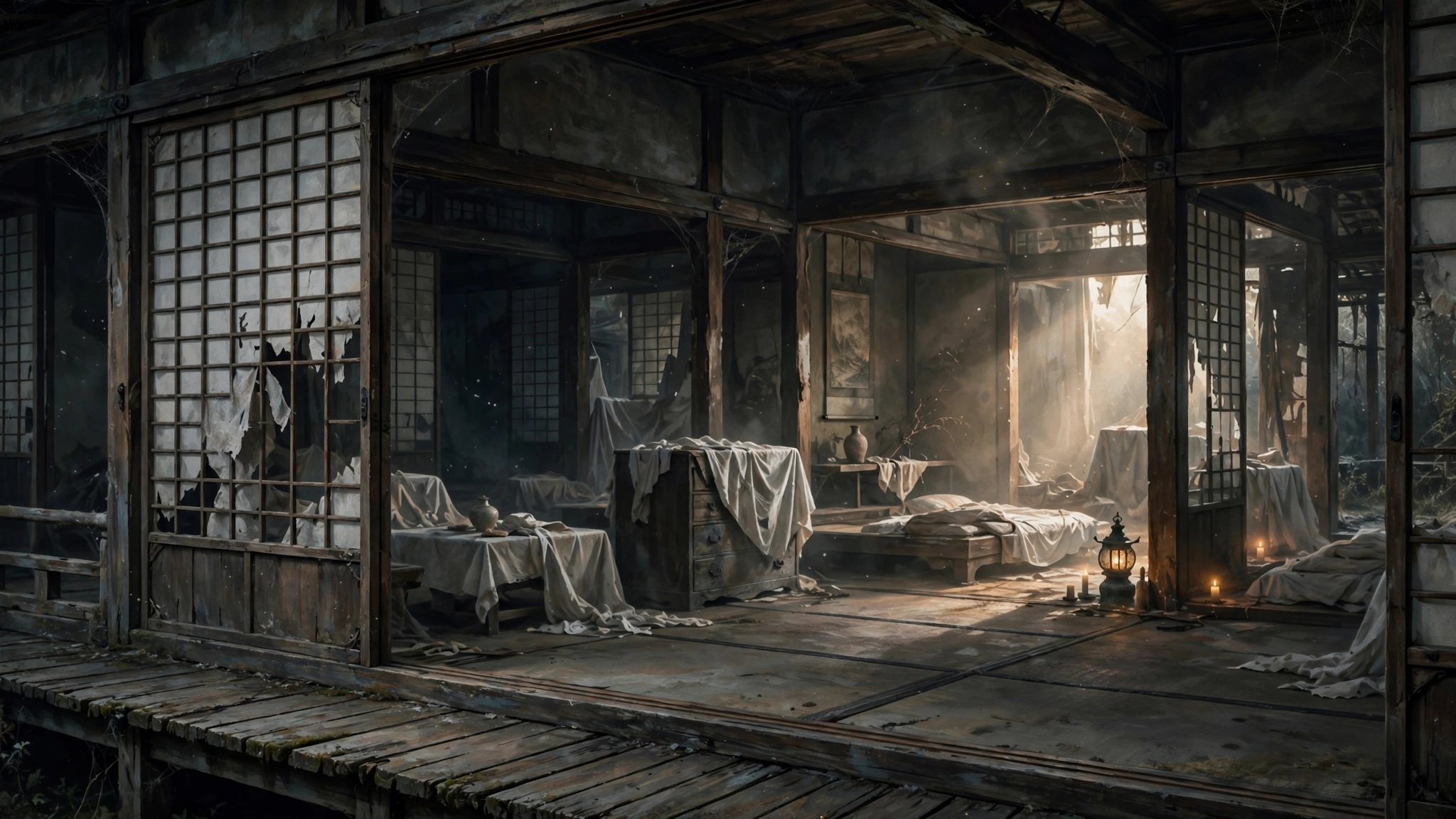 The House He Left Behind.
Nagao married, as an only son of his era was expected to. He kept making offerings before O-Tei’s tablet even after the wedding, a loyalty that had simply become part of him. But memory does to the dead what memory always does — it softens, the way a dream softens on waking. Her image grew dim in his mind, like a dream that is hard to recall. His parents died. Then his wife. Then his only child. Within a few seasons, Nagao stood in a house entirely emptied of the people who had filled it, and he could not remain inside its rooms.
He left, and took to the road the way grieving men of his century sometimes did — without destination, hoping that distance might accomplish what time had not. It was on that aimless route that he arrived at Ikaho, a hot-spring village high in the mountains of what is now Gunma Prefecture, known then as now for its mineral waters and for the long stone steps — the ishidan — that climb through the heart of the village, with inns and shops ranged along either side.
In the lamp-lit dining room of one such inn, a servant girl passed him carrying a tray, and Nagao forgot, for a long moment, how to breathe. He told himself it was grief playing tricks with a tired mind. Then she passed again, and the voice was not similar — it was identical, pitched exactly as it had been seventeen years before, in a room in Niigata he had spent two decades trying not to re-enter in memory.
He asked her name. She answered immediately, in the same unhurried cadence the dying girl had used at her own bedside: she was O-Tei. He was Nagao Chōsei of Echigo, her promised husband. She had died in Niigata seventeen years before. He had written a vow, sealed it, and placed it beside her memorial tablet. That, she told him, was why she had come back. Then, the source records, she lost consciousness the instant the final word left her.
Archival Roots: Hearn, Kwaidan, and the Grammar of Rebirth
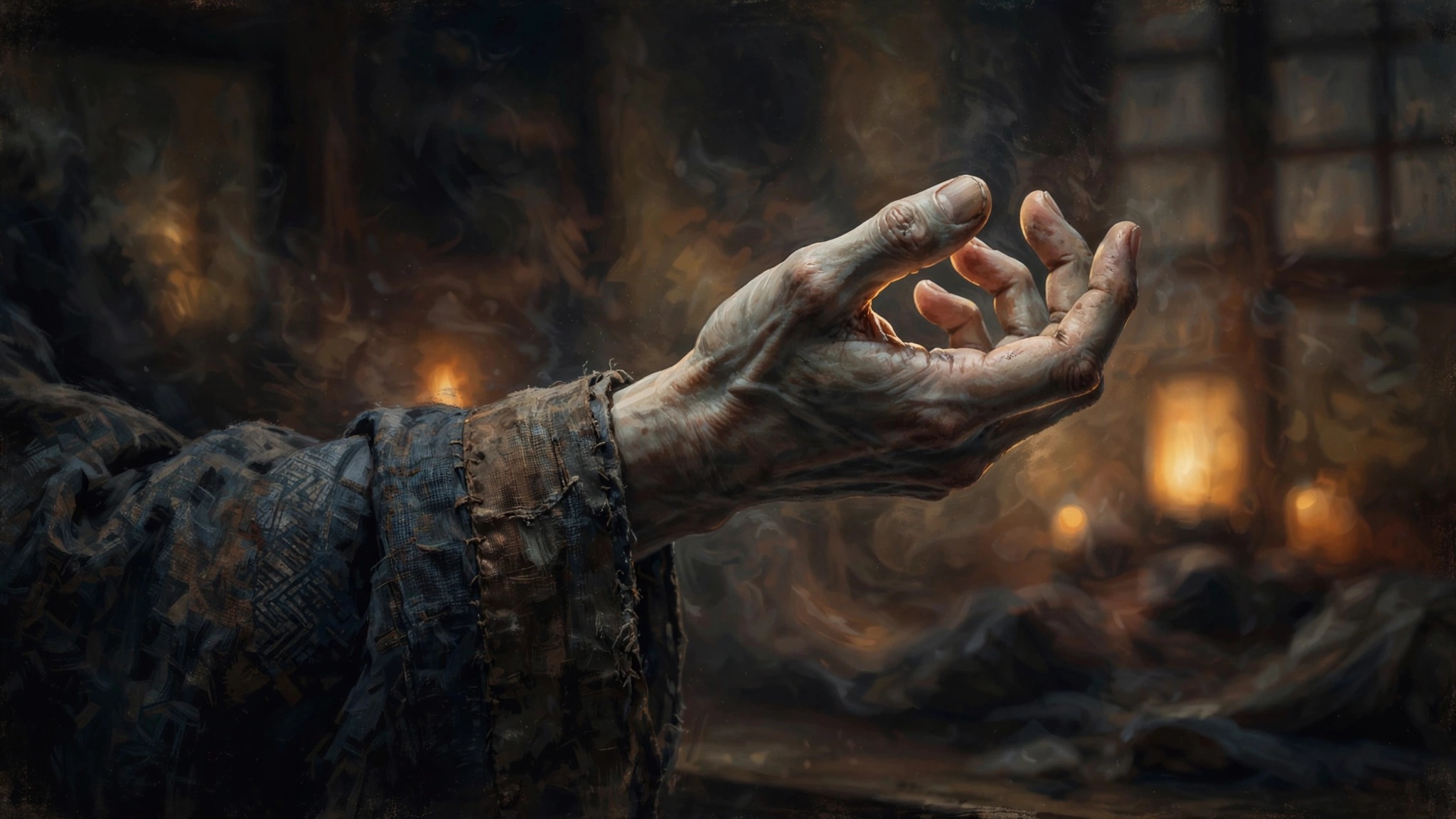 A Hand Reaching Across Years.
Hearn published this account in 1904 in Kwaidan: Stories and Studies of Strange Things, a collection assembled during his years in Meiji Japan. His own preface is unusually candid about method: “Most of the following Kwaidan, or Weird Tales, have been taken from old Japanese books” — Yasō-Kidan, Bukkyō-Hyakkwa-Zenshō, Kokon-Chomonshū, Tama-Sudaré, Hyaku-Monogatari. For this particular tale the book in question is known: 石川鴻斎’s 『夜窓鬼談』 (Ishikawa Kōsai’s Yasō Kidan, 1889), whose upper volume contains the kanbun story 「怨魂借體」 (Enkon Shaktai, “a spirit borrowing a body”). In the original, the woman is a courtesan named 阿貞 — and the reading written beside her name is おさだ, osada. Hearn, retelling her, renamed her “O-Tei.” The English text most Western readers know is therefore a translation of a translation, and the Japanese version that circulated here after the war — the work of 田部隆次 (Tabe Ryūji), collected in the 1937 『小泉八雲全集第八卷 家庭版』 — is Hearn’s English rendered back into Japanese.
That chain explains the one detail most retellings get backwards. Osada is the older name; “O-Tei” is Hearn’s. The same chain also explains a smaller slip: Hearn’s English opens the story “in the town of Niigata, in the province of Echizen,” while his own dialogue has the woman name him “Nagao Chōsei of Echigo.” Echizen is Fukui; Echigo is Niigata, and Niigata is where the story happens. The Japanese translator silently corrected the opening sentence and left the dialogue as it stood.
The belief structure underlying O-Tei’s promise did not originate with Hearn. Shichishō — the seven-lifetime bond of marriage — is a concept rooted in Japanese Buddhist cosmology, distinct from the Pure Land doctrine Nagao first offers her at the bedside. Her correction of his theology is the hinge of the entire tale: she is not interested in a reunion beyond death, but a return into it, into the same world of inns, tea trays, and mountain steam he is still obligated to inhabit.
The Weight of Forgetting: Reading O-Tei as Edo-Period Kaidan
What distinguishes this tale within Japanese folklore is its refusal of spectacle. There is no haunting, no curse, no demand for vengeance — only a sealed document and a disease the period’s medicine had no answer for. Consumption, understood in the Edo years this tale inhabits as an illness without recourse, functions in the narrative less as plot device than as the quiet engine of inevitability: the thing that makes the vow necessary in the first place.
Hearn’s account is notably silent on the mechanism of the return. The text does not explain how memory crossed from one life into another, nor why it surfaced only in that single lamp-lit moment and then sealed itself shut again, permanently. O-Tei married Nagao and, by Hearn’s telling, the marriage was a happy one — but she never again recalled the deathbed, the vow, or the seventeen years she had promised to cross. The record offers no further word from her on what she had felt in that instant of recognition.
This silence is, in its own way, the most unsettling detail in the entire account. A reader hoping for an explanation of rebirth, proof of the soul’s continuity, or some closing theological statement will not find one here. The tale offers only the fact of the thing happening, recorded the way Hearn insists it was given to him — and then withdraws, leaving the stone steps of Ikaho to carry the weight of what was said and immediately, irrecoverably forgotten.
Historical Legacy & Archival Footnotes
“O-Tei” entered the English-speaking world through Hearn’s 1904 Kwaidan, a volume that also contains better-known tales such as “Yuki-Onna” and “Hoichi the Earless.” Masaki Kobayashi’s celebrated 1964 anthology — released internationally as Kwaidan — drew on four of Hearn’s stories, among them “Hoichi the Earless” and “Yuki-Onna.” This one was not among them, and has never been filmed.
The lineage runs on past Hearn. The documented trail goes from Kōsai’s 「怨魂借體」 to Hearn’s “O-Tei” and then to the first night of Natsume Sōseki’s 『夢十夜』 (Yume Tenshi, 1910), which borrows the same device of a promise carried across death and a reunion that closes the door on the memory behind it.
Ikaho Onsen remains an active hot-spring town in Gunma Prefecture today. The stone steps at its center were formed in 1576, when seven families moved the hot-spring source to its present site and laid out the village around it; the steps as they stand today were remodeled between 1980 and 1985, and were extended to 365 in 2010 — the number chosen so that the street would be busy every day of the year. They are still lined with inns and bathhouses much as the narrative describes. No specific inn is named in Hearn’s text, and no physical trace of Nagao’s household shrine or his sealed vow is known to survive; the story’s geography is verifiable, but its relics, if they ever existed, are not.
What the tale offers the modern reader is less a ghost story than a meditation on the asymmetry of memory and devotion. Nagao carried his vow, unaltered, across seventeen years of ordinary losses. O-Tei, reborn, carried nothing at all — until the one moment she was required to, after which the knowledge closed over her like water settling. The story does not resolve whether this is mercy or a kind of quiet erasure, and it is, perhaps, exactly that refusal to decide which has kept the tale alive in the long archive of Japanese folklore.
Primary Texts & Scholarly References
- 石川鴻斎 (1889), 『夜窓鬼談』上巻「怨魂借體」 — the original Japanese tale, in classical Chinese-style prose; the woman is named 阿貞〔おさだ〕. National Diet Library digital collection, pid 896581.
- Lafcadio Hearn (1904), Kwaidan: Stories and Studies of Strange Things, “The Story of O-Tei” — the English retelling that carries the story into Western literature.
- 田部隆次 訳 (1937), 「お貞のはなし」in 『小泉八雲全集第八卷 家庭版』, 第一書房 — the Japanese rendering of Hearn’s text that this article follows; Aozora Bunko, card 59735.
- 平川祐弘 (1996), 『オリエンタルな夢 — 小泉八雲と霊の世界』, 筑摩書房 — on Hearn’s reworking of Kōsai’s tales and the spirit tradition behind them.
- 『比較文学』第54号 (2011), pp. 149–151 — the documented lineage 鴻斎「怨魂借體」→ Hearn「お貞の話」→ 漱石『夢十夜』第一夜.
- Asai Ryōi (1666), Otogi Bōko — the Edo-period collection that established the returning beloved as a fixture of Japanese ghost literature.
- Ueda Akinari (1776), Ugetsu Monogatari — the same devotion outlasting death, in Akinari’s keyaki.
- 渋川市公式ホームページ「石段街」 — official municipal history of Ikaho’s stone steps (1576; remodeled 1980–1985; 365 steps in 2010).
Soundtrack & Audio Credits
Music: ‘Black Water’ by Kraosando (https://kraosando.bandcamp.com) — Licensed under CC BY 4.0